AI Act transparency requirements: what Irish SMEs must do
If a customer, tender or board member is asking whether your business tells people when they are dealing with AI, the short answer is this: Article 50 of the EU AI Act sets four transparency duties, and which of them land on you depends on whether you build AI systems (a provider) or use them in your business (a deployer). The duties have applied since 2 August 2026. Most SMEs that only use someone else's chatbot or writing tool have a small set of duties. SMEs that build or resell generative AI have more.
This guide is for IT managers, operations directors and compliance leads in businesses of roughly 10 to 250 people, and for the MSPs and accountants who advise them. It helps most with one of four jobs: answering a customer security questionnaire, passing an audit, reporting to the board, or being ready when a regulator asks. It is not legal advice. Where the answer turns on interpretation, take legal advice.
Key Takeaways
- Article 50 covers four situations: AI that talks to people, AI that generates synthetic content, deepfakes, and AI-written text published on matters of public interest.
- Providers carry the design and marking duties. Deployers carry the labelling duties for deepfakes and public-interest text.
- Exceptions are narrow and the Commission reads the "obvious AI" exception restrictively, so record your reasoning.
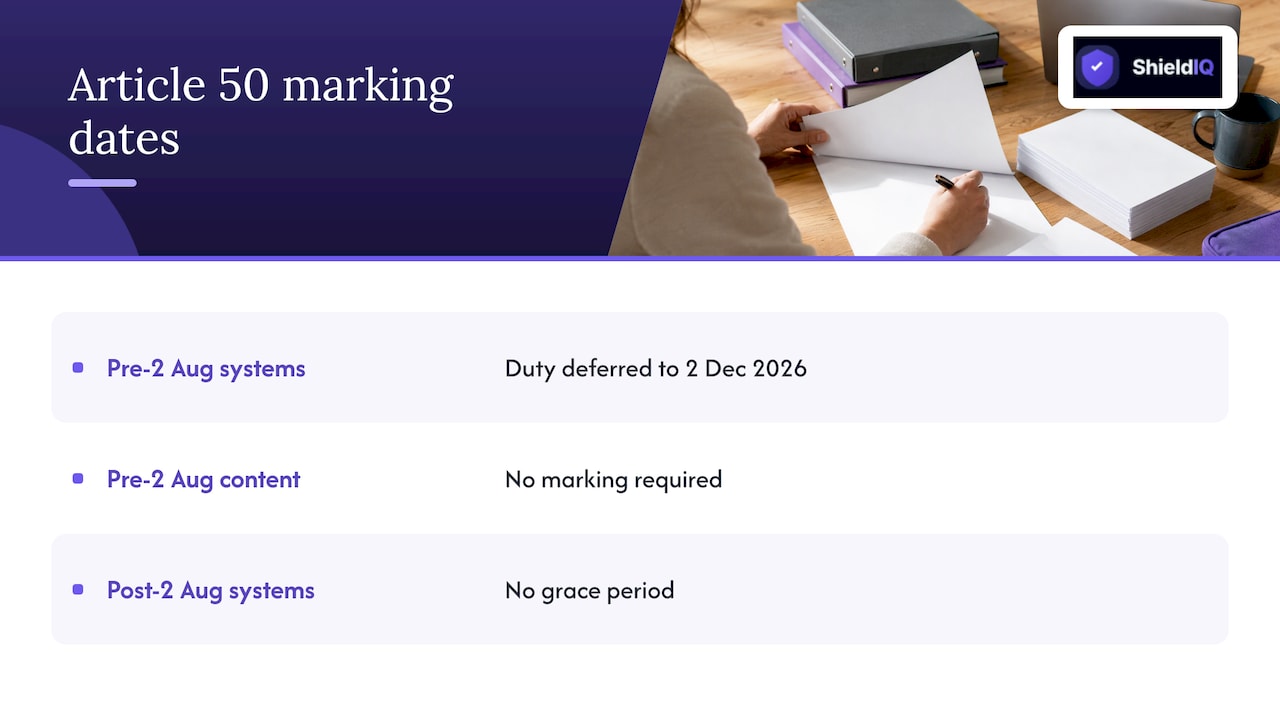
- Generative systems already on the market before 2 August 2026 have until 2 December 2026 for machine-readable marking.
- Most Irish SMEs will be supervised at EU level for marking, unless they are also a media or online service.
Table of Contents
- Who the transparency rules apply to
- The four duties at a glance
- Duty 1: telling people they are interacting with AI
- Duty 2: marking AI-generated content
- Duty 3: labelling deepfakes and AI text
- The Code of Practice
- Who supervises this in Ireland
- Putting it into practice: five steps
- What to do this week
- Our view on transparency work
- How ShieldIQ helps with the AI Act
- FAQ
- Sources
Who the transparency rules apply to
The Irish Department of Enterprise, Tourism and Employment says most organisations are affected if they develop, use, supply or distribute AI systems in the EU, whether as providers, deployers, importers or distributors. The Act covers the public and private sectors and can reach organisations outside the EU where an AI system affects people in the Union.
Two terms matter throughout:
- Provider: the organisation that develops an AI system, or has it developed, and puts it on the market under its own name.
- Deployer: the organisation that uses an AI system in its professional activity.
You can be both. A software firm that builds a support chatbot into its product is a provider of that chatbot. The same firm using a third-party image generator for its marketing is a deployer of that tool.
Personal, non-professional use is outside the Act. The Commission's Article 50 FAQ explains that regular economic benefit or business, trade, occupational or freelance activity makes a natural person a deployer. Employees acting under your company's control are not separate deployers: the duty sits with the business.
The four duties at a glance
| Duty | Article 50 paragraph | Who carries it | What it asks |
|---|---|---|---|
| Tell people they are talking to AI | 50(1) | Provider | Design the system so people are informed |
| Mark synthetic content | 50(2) | Provider | Machine-readable marking and detection means |
| Label deepfakes | 50(4) | Deployer | Disclose the content is artificially generated or manipulated |
| Label AI text on public-interest matters | 50(4) | Deployer | Disclose, unless human-reviewed under editorial responsibility |
Paragraph 50(5) then requires that the information be clear, distinguishable and accessible, at the latest at first exposure. The consolidated text is on the AI Act Service Desk.
Duty 1: telling people they are interacting with AI
Article 50(1) requires providers to design AI systems that interact directly with people so that those people are informed they are dealing with an AI system. The exception is where this is obvious to a reasonably well-informed, observant and circumspect person.
The Commission's guidelines set four cumulative tests for when this duty applies:
- It is an AI system.
- It is designed for genuine two-way exchange, not just data collection or automated replies.
- The interaction is direct: the AI communicates with the person, not through a human intermediary.
- The other party is a natural person, whether consumer, professional or other user.
Background and machine-to-machine systems are out of scope, as the Commission's FAQ sets out.
What a good notice looks like
The Commission's guidelines say the notification should be built into the design, given at the latest at first interaction, and state plainly that the counterpart is not human. Examples include a chatbot saying it is AI-based, an AI label on generated emails, or a voice assistant announcing that it is AI-powered.
One prominent notice is usually enough. Periodic reminders are expected in riskier settings: children, elderly or vulnerable people, financial, health or legal advice, AI companions and AI agents. Where children may use the system, the wording needs to be child-friendly.
Do not lean on "it's obvious"
The same guidelines read the obviousness exception restrictively, because it removes a protection from the person. A provider relying on it has to assess and be able to demonstrate that it is obvious in the specific context of use. A website chat window with a friendly human name and photo is not obvious. A support bot labelled "AI assistant" in the header is simple to defend. For the questionnaire job, a one-line note saying where and how the notice appears is stronger evidence than an argument about obviousness.
Duty 2: marking AI-generated content
Article 50(2) applies to providers of AI systems that generate synthetic audio, image, video or text. Outputs must be marked in a machine-readable format and detectable as artificially generated or manipulated. If you only use a generative tool from a vendor, this duty sits with the vendor, not you. If you build or white-label one, it sits with you.
There are two exceptions in the Article 50 text: systems that perform an assistive function for standard editing or do not substantially alter the input data or its meaning, and systems authorised by law to detect, prevent, investigate or prosecute criminal offences.
The technical bar is realistic. The solution only has to be as robust as is technically feasible given the state of the art and the cost. Watermarks, metadata and similar techniques are all in play, and you do not need to keep a full provenance chain for every output.
The 2 December 2026 date
For generative AI systems placed on the market before 2 August 2026, Article 111(4) defers the machine-readable marking duty until 2 December 2026. Content generated before 2 August 2026 does not need to be marked, according to the Article 50 primer from AI Austria. Systems placed on the market after 2 August 2026 have no such grace period. If you are a provider and unsure which side of the line you sit on, that is a point for legal advice.
Duty 3: labelling deepfakes and AI text
These duties fall on deployers, which is where most SMEs sit if they use AI for marketing or communications.
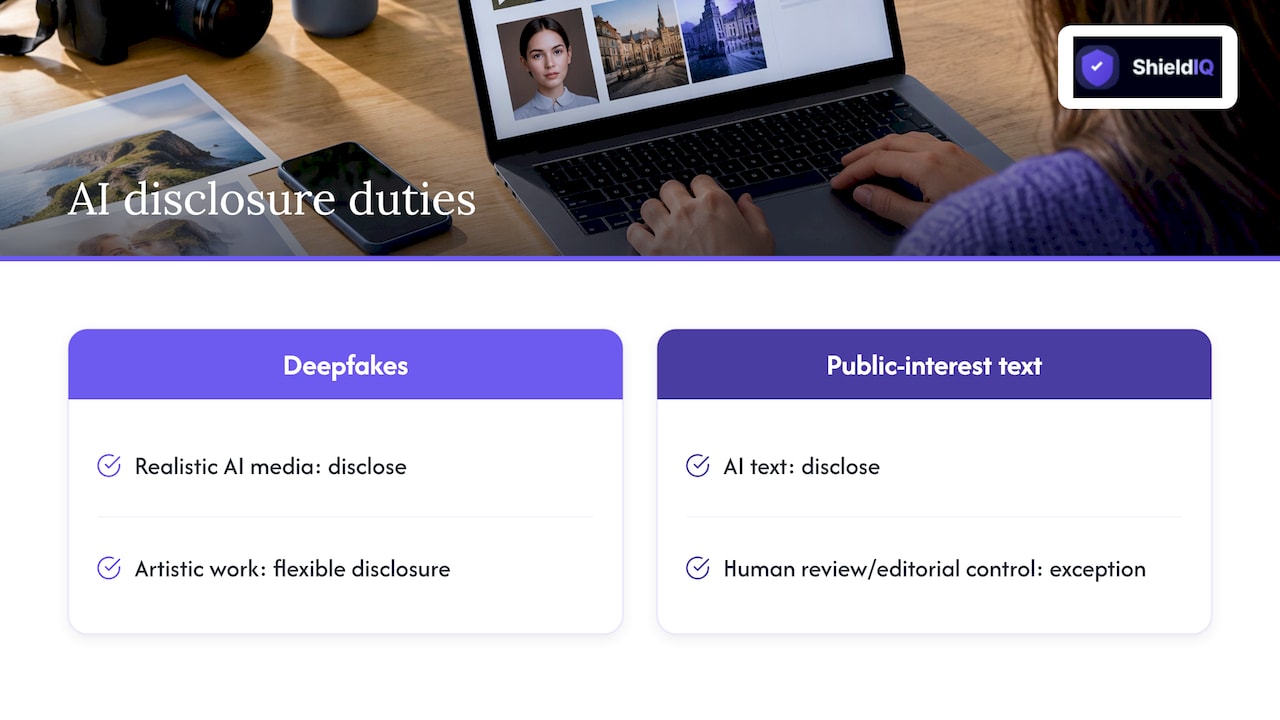
Deepfakes. If you publish image, audio or video that has been artificially generated or manipulated and looks like real people, objects, places or events, you must disclose it. For evidently artistic, creative, satirical or fictional work, the disclosure can be made in a way that does not spoil the work.
Public-interest text. If you publish AI-generated or manipulated text to inform the public on matters of public interest, you must disclose that. The exception is where the text has been human-reviewed or is under editorial control, with a person holding editorial responsibility. Both points are in the Article 50 text.
The line that matters for most SMEs is public interest. A product description drafted with AI is not that. A published statement on a local planning dispute, a public health matter or an election could be. Where you are unsure, treat it as in scope and have a named person review and approve it.
The optional EU icon
The Commission offers an EU icon for labelling AI-generated content. It should be clearly visible at first exposure, with no overlay in front of it, embedded in the content itself, and should stay visible when the content is reshared or downloaded. The icons are optional. Meeting Article 50 remains your responsibility whether you use them or a plain text label.
If your team is already using AI to speed up marketing, this overview of AI workflows for Irish small businesses shows the kind of everyday uses where a labelling rule should be agreed first.
The Code of Practice
The Commission has published a Code of Practice on transparency of AI-generated content, covering Article 50(2), (4) and (5). It was drawn up by independent experts and facilitated by the AI Office. Adherence is voluntary, but the Commission and the AI Board have confirmed it is an adequate way to demonstrate compliance. Generative AI deployers who do not adhere must demonstrate compliance with the marking and labelling duties themselves. For an SME, adhering usually means less to explain to a customer or auditor.
Who supervises this in Ireland
Ireland uses a distributed model with sector-based authorities. Under S.I. No. 405/2026, Coimisiún na Meán is the market surveillance authority for Article 50 where the provider or deployer is a listed intermediary, audiovisual media, sound broadcasting, designated online or hosting service. The Central Bank of Ireland is designated for specified high-risk AI systems used by regulated financial service providers. Coimisiún na Meán confirms on its AI Act page that it is one of 15 market surveillance authorities designated under that instrument.
The Irish firm FourWinds notes in its analysis of who regulates AI in Ireland that the instrument names no Irish body for the marking duty unless the business is itself an online or broadcast service. Its reading is that a business using another provider's chatbot has duties only for its own deepfakes, public-interest text, emotion recognition or biometric categorisation. How that applies to you is a legal question, so confirm with a solicitor if your position is borderline.
A missing national supervisor is not a reason to wait. Customers, insurers and tender evaluators ask the question regardless.
Putting it into practice: five steps
- List your AI uses (about 60 minutes). Note every chatbot, content generator, voice tool and AI feature in your own product. Ask each department, because marketing and support often adopt tools without telling IT.
- Sort each use into provider or deployer (30 minutes). If you built it or sell it under your name, you are the provider. If you use it in your work, you are the deployer.
- Match each use to a duty (60 minutes). Use the table above. Anything that talks to customers goes against 50(1). Anything you publish that is synthetic media or public-interest text goes against 50(4).
- Fix the notices and labels (1 to 3 days). Add the chatbot disclosure, agree a label wording for synthetic media, and name the editor who signs off public-interest text.
- Keep a short record (30 minutes per use). Write down what you decided, where the notice appears and who approved it. Include a screenshot. This is the evidence for the questionnaire, the audit file and the board paper.
The five steps take most SMEs a week or two of part-time effort. Providers who must add machine-readable marking should plan engineering time on top and make sure it is finished before 2 December 2026 where that date applies to them.
What to do this week
- Ask each team which AI tools they use with customers or in published content, and put the answers in one list.
- Decide, for each tool, whether you are the provider or the deployer.
- Check that every customer-facing chatbot says it is AI at first contact.
- Name one person who approves AI text or synthetic media before it is published for the public.
- If you provide a generative system, confirm the date it was placed on the market and plan your marking work against the 2 December 2026 deadline.
- Read the Article 50 text once yourself, so you can talk to your adviser or solicitor in specifics.
Our view on transparency work
Transparency is the part of the AI Act that a customer can see for themselves. A questionnaire asks "do you tell people when they are talking to AI?" and the honest answer is either a screenshot or an apology. Teams without a security function do best when they treat it as a small register: each AI use, the duty it triggers, the notice, the approver and the date.
At ShieldIQ, we built our platform in Ireland for teams that do not have a security team. We help you assess, prioritise, document and evidence your position, and we are clear that certification, where a scheme offers it, comes from an accredited body and not from us. Our broader EU AI Act guide for SMEs and scope and deadlines article set the wider picture around Article 50.
Matthew Lemon
How ShieldIQ helps with the AI Act
ShieldIQ is an AI-powered governance, risk and compliance platform built in Ireland for SMEs and the IT managers, operations directors and compliance leads inside them. It supports 17 frameworks, including the EU AI Act, ISO 42001 and NIST AI RMF, and you can keep your AI inventory, policies and evidence in one place. Customer data is hosted in the EU (Ireland) on AWS, and AI analysis is processed by Anthropic (Claude), which does not train on customer data. The Starter plan is free with no card, and the pricing page lists the paid plans. A first baseline assessment takes about 15 minutes; see our EU AI Act page for SMEs.
FAQ
Does Article 50 apply if I only use ChatGPT-style tools internally?
Usually the chatbot duty sits with the provider, not with you as a user. Your own duties arise if you publish deepfakes or AI text on matters of public interest. Staff using a tool under the company's control are not separate deployers, as the Commission's FAQ explains.
Do I have to label every AI-written marketing text?
The text duty covers AI-generated or manipulated text published to inform the public on matters of public interest. It does not apply where a person has reviewed it or holds editorial responsibility for it. Routine marketing copy is generally a different category, but if you are unsure, take legal advice.
Which Irish body will check my compliance?
That depends on what you do. Coimisiún na Meán covers listed media and online services, and the Central Bank covers specified high-risk systems in financial services, under S.I. No. 405/2026. For many SMEs the marking duty is supervised at EU level.
Is the Code of Practice mandatory?
No. Adherence is voluntary, but the Commission and the AI Board have confirmed it is an adequate way to demonstrate compliance, according to the Commission's Code of Practice page. Deployers who do not adhere must show compliance by other means.
Sources
- The EU AI Act and my organisation, Department of Enterprise, Tourism and Employment
- Article 50: Transparency obligations, AI Act Service Desk
- Transparency obligations under Article 50 of the AI Act, European Commission FAQ
- Commission guidelines on Article 50, EUR-Lex
- Article 50 primer for AI start-ups, AI Austria
- EU icons for labelling AI-generated content, European Commission
- Code of Practice on transparency of AI-generated content, European Commission
- S.I. No. 405/2026, Irish Statute Book
- EU Artificial Intelligence Act, Coimisiún na Meán
- Who regulates AI in Ireland, FourWinds
- AI workflows for Irish small businesses