Drata alternatives for EU teams: best options in 2026
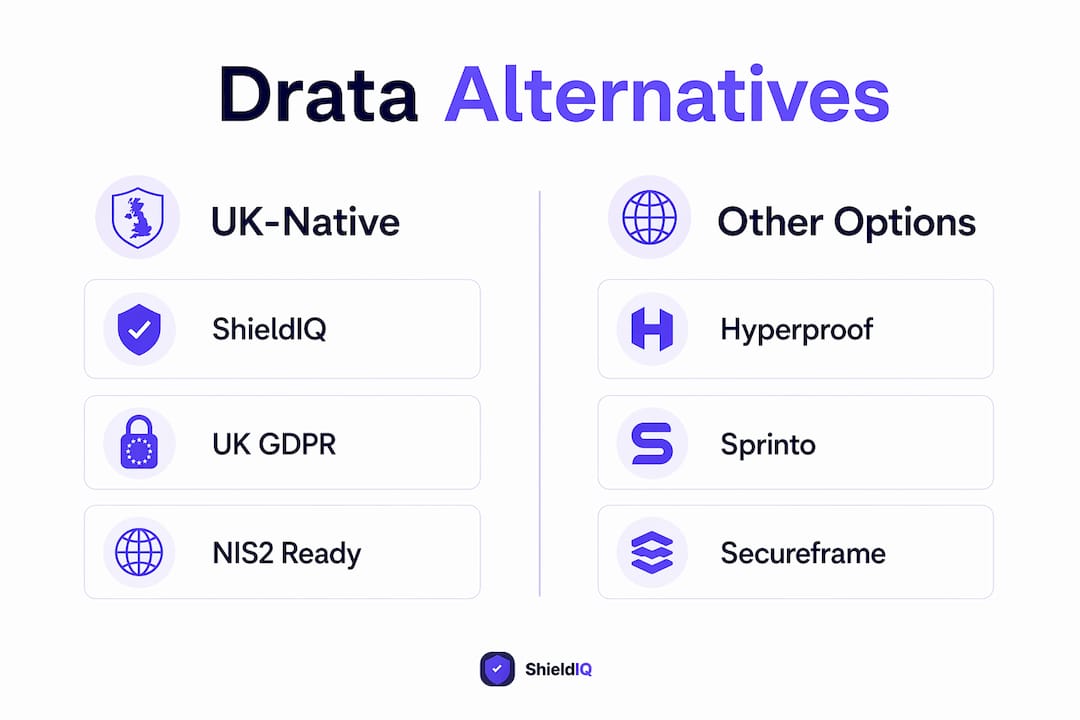
For SMEs seeking a direct, audit-ready replacement, Shieldiqcyber’s ShieldIQ platform is the strongest Drata alternative because it combines automated cross-framework compliance with EU regulatory alignment (GDPR, NIS2, DORA, ISO 27001) and optional consultancy, all without requiring a full-time security team. If your exit reason is enterprise scale, you may also evaluate enterprise GRC platforms such as Hyperproof or OneTrust. For fast-track, cost-focused needs, platforms like Sprinto or Secureframe offer quicker onboarding. For bundled audit services, specialist vendors combine software with auditor coordination in a single engagement.
What follows is a concise TL;DR, a side-by-side comparison table, per-category breakdowns, and a detailed case for ShieldIQ as the recommended, native option.
Table of Contents
-
The compliance platform market is more nuanced than the shortlists suggest
-
ShieldIQ helps teams move off Drata without the usual friction
TL;DR: which Drata alternative fits your situation?
Pick your exit reason and match it to the right category:
-
Cost at scale or renewal inflation: Fast-track, self-service platforms (Sprinto, Secureframe) tend to offer more transparent, lower entry pricing and quicker time-to-first-evidence. Best for sales-driven teams needing audit proof for deals.
-
Insufficient onboarding or customer success: Platforms with dedicated compliance managers and hands-on CS (Secureframe, Hyperproof) reduce the internal burden during setup. Look for assigned support, not just a ticket queue.
-
Missing native data security (DLP/DSPM): Compliance platforms rarely discover or classify sensitive data natively. If you handle regulated data under GDPR or SOC 2 CC6.x controls, look for a platform that integrates with or bundles DLP/DSPM capabilities.
-
Enterprise scale or complex multi-framework programmes: Enterprise GRC platforms (Hyperproof, OneTrust) offer deeper workflow customisation, multi-entity support, and broader framework libraries, though at higher cost and longer implementation timelines.
-
Bundled audit services: Some vendors include auditor coordination in the first year, reducing the friction of managing software and auditor separately.
Recommended for SMEs: Shieldiqcyber’s ShieldIQ is the only option on this list built with EU regulatory alignment at its core, covering NIS2, GDPR, DORA, and ISO 27001 with optional vCISO and audit preparation consultancy for teams without an in-house security function.
What does Drata actually do?
Drata automates continuous monitoring, evidence collection, policy management, and provides an auditor portal for frameworks including SOC 2, ISO 27001, HIPAA, and GDPR. Its core proposition is reducing the manual work of gathering audit evidence by connecting to your cloud infrastructure, identity providers, and code repositories, then surfacing control status in a centralised dashboard.
Drata also offers a trust centre, policy templates, and a personnel management module for security training acknowledgements. Pricing is quote-based and modular, with costs scaling by framework, user count, and additional capacity. That modularity is both a strength and a common source of friction at renewal.
Why teams look for Drata alternatives
Buyer reports consistently identify a handful of recurring exit reasons. Recognising yours early makes the evaluation process significantly shorter.
-
Cost at scale and renewal inflation: Modular, per-framework pricing means costs compound as you add frameworks or grow headcount. Renewal increases catch many teams off guard.
-
Onboarding and customer success gaps: Some teams find the self-serve model insufficient, particularly when compliance ownership sits with a non-specialist (an IT manager rather than a dedicated GRC lead).
-
Missing native DLP/DSPM: Drata checks controls but does not natively discover, classify, or remediate sensitive data. Evidencing SOC 2 CC6.x or GDPR Article 32 controls often requires a separate tool.
-
Multi-framework complexity: Adding frameworks beyond the first one increases both cost and operational complexity. Teams running ISO 27001, NIS2, and DORA simultaneously can find the workflow model cumbersome.
-
AI and GenAI governance gaps: As organisations face EU AI Act obligations, platforms without AI governance modules leave a coverage gap.
-
Integration gaps for niche stacks: Teams on non-mainstream infrastructure (Bitbucket, on-premise IdP, legacy MDM) often hit integration limits.
Practical consequences when these gaps go unaddressed: audit timelines slip, deals stall because a prospect’s security questionnaire cannot be answered quickly, and compliance staff spend hours on manual evidence uploads instead of higher-value work.
Pro Tip: Renewal negotiation is one of the highest-impact decisions in the procurement cycle. Lock multi-year, price-protected terms before you sign, not at renewal, when your leverage is lowest.
At-a-glance comparison for buyers
| Category | Best for / target buyer | Frameworks supported (examples) | Automation and evidence collection | Integration breadth | Managed services | Price band (indicative) | UK/EU data residency and support | DLP/DSPM integration |
|---|---|---|---|---|---|---|---|---|
| ShieldIQ (native option) | SMEs needing NIS2, GDPR, DORA, ISO 27001 readiness without a full-time security team | NIS2, GDPR, ISO 27001, DORA, SOC 2, EU AI Act | Automated controls, cross-framework mapping, AI policy generation, gap analysis, network scanning | Cloud platforms, IdP, ticketing, MDM, code repos | vCISO, audit prep, GRC strategy, security awareness training | Subscription tiers; consulting available separately | EU-aligned; local support | Integration-ready; security posture visibility |
| Enterprise GRC platforms | Mid-market to enterprise; complex multi-framework programmes; security-led teams | SOC 2, ISO 27001, HIPAA, GDPR, NIST, DORA, NIS2 | Deep workflow automation; audit management; risk registers | Broad; hundreds of native connectors | Professional services; implementation partners | Higher; typically five figures annually | EU/UK data residency options; enterprise SLAs | Varies; often requires separate tooling |
| Fast-track, cost-focused platforms | Startups to scale-ups; sales-driven teams needing rapid audit proof | SOC 2, ISO 27001, HIPAA, GDPR | Automated evidence collection; self-service onboarding | Wide cloud and IdP coverage; some gaps on niche stacks | Limited; ticket-based CS | Lower entry cost; modular add-ons | US-primary; EU data residency available on higher tiers | Generally absent; separate tool needed |
| Bundled audit vendors | Teams wanting software and auditor coordination from one vendor | SOC 2, ISO 27001 (primary) | Evidence collection plus auditor-managed review | Moderate; sufficient for common stacks | Audit coordination included in first year | Mid-range; bundled pricing | Varies by vendor | Generally absent |
| Data security and compliance bundles | Teams handling sensitive data under GDPR or SOC 2 CC6.x; security-led buyers | SOC 2, GDPR, ISO 27001 | Compliance automation plus native DLP/DSPM | Cloud-native; strong data-flow visibility | Limited managed services | Mid-to-high; DLP adds cost | US-primary; EU options vary | Native DLP/DSPM built in |
| Mid-market, hands-on CS platforms | Mid-market teams needing structured onboarding and recurring compliance manager support | SOC 2, ISO 27001, HIPAA, GDPR, NIST | Solid automation; centralised compliance operations | Strong; task management and ticketing integrations | Dedicated compliance managers; audit readiness support | Mid-to-high; per-user or per-framework | EU/UK residency options; responsive EU timezone support | Partial; integrations available |
Price bands are indicative and based on publicly available information and buyer reports. Actual quotes depend on user count, framework scope, and contract length. Always request a scoped, multi-year quote.
How we evaluated these alternatives
The goal was to identify options that genuinely serve SMEs and mid-market organisations preparing for audit under NIS2, GDPR, DORA, or ISO 27001 in 2026. The evaluation prioritised practical audit readiness over feature breadth.
Criteria used:
-
Frameworks supported: coverage of elevant standards (NIS2, GDPR, DORA, ISO 27001, SOC 2, Cyber Essentials)
-
Automation depth: continuous monitoring, automated evidence collection, gap analysis, AI-assisted policy generation
-
Integration breadth: cloud platforms, identity providers, ticketing systems, code repositories, MDM
-
DLP/DSPM support: native or integrated data discovery and classification for evidencing data-handling controls
-
EU data residency and local support: data stored within UK/EU boundaries; support available in EU business hours
-
Pricing transparency: publicly available pricing or clear quote-based model with documented scope
-
Customer success and onboarding: assigned CS, compliance managers, or consulting available
-
Audit-readiness features: auditor portal, export formats, evidence packaging, Type I/II report support
-
Scalability: multi-framework, multi-entity, and multi-tenant support
Sources used include industry comparison guides, buyer reviews on G2 and Capterra, vendor documentation, and ShieldIQ product proof points for the local recommendation.
Detailed breakdown: top alternative categories and ShieldIQ
ShieldIQ: the recommended EU-native option
Shieldiqcyber’s ShieldIQ is built specifically for SMEs that need to demonstrate compliance with GDPR, NIS2, DORA, ISO 27001, and SOC 2 without hiring a full-time security team. The platform automates compliance assessments, maps controls across frameworks simultaneously (so a single control can satisfy requirements in multiple standards), generates AI-driven policies tailored to your organisation, and maintains a risk and asset register alongside a vendor management module and incident workflows.

Evidence collection is automated across connected systems, and the platform produces auditor-ready exports and gap analysis reports. For teams that need more than software, Shieldiqcyber offers optional consulting services: Virtual CISO, audit preparation, and security awareness training. That combination of platform and consultancy is what distinguishes ShieldIQ from purely self-serve alternatives.
Pros:
-
Cross-framework mapping reduces duplication across NIS2, GDPR, DORA, and ISO 27001
-
AI policy generation cuts the time to produce compliant documentation
-
Optional vCISO and audit prep consultancy for teams without in-house expertise
-
EU regulatory alignment built in, not retrofitted
-
Network scanning and security posture visibility alongside compliance workflows
Cons:
-
Smaller integration library than the largest US-headquartered platforms
-
Consulting services are priced separately from the platform subscription
Ideal for: SMEs and mid-market organisations that need multi-framework compliance, local regulatory alignment, and the option to bring in expert support without committing to a full-time hire.
Pricing: Subscription tiers based on number of frameworks, modules, users, and AI credits. Consulting services (vCISO, audit prep, GRC strategy) are available as one-off or retainer engagements. Pricing is not publicly listed; contact Shieldiqcyber for a scoped quote.
EU-specific notes: Shieldiqcyber is aligned to EU regulatory requirements. ISO 27001 support and DORA readiness are core product capabilities, not add-ons.
Enterprise GRC platforms (Hyperproof, OneTrust)
Enterprise GRC platforms offer the deepest workflow customisation, the broadest framework libraries, and the most mature audit management capabilities. Hyperproof, for example, centralises compliance operations with strong evidence collection automation, recurring task management, and integrations with task management and ticketing tools. OneTrust extends further into privacy, consent management, third-party risk, and AI governance, making it a credible option for organisations with complex data-use obligations under GDPR.
Pros:
-
Broad framework coverage including NIST, DORA, NIS2, HIPAA, and ISO 27001
-
Deep audit management and risk workflow capabilities
-
Strong integration ecosystems
Cons:
-
Higher cost and longer implementation timelines
-
UX complexity; meaningful training investment required
-
Breadth can feel like multiple products stitched together for smaller teams
Ideal for: Mid-market to enterprise organisations with dedicated GRC or security teams, complex multi-entity programmes, or regulatory obligations spanning multiple jurisdictions.
Pricing: Typically five figures annually; quote-based. OneTrust pricing is not publicly listed.

EU-specific notes: Both platforms offer EU/UK data residency options at enterprise tier. EU-timezone support is available but may depend on contract level.
Fast-track, cost-focused platforms (Sprinto, Secureframe)
Sprinto and Secureframe target startups and scale-ups that need to reach SOC 2 or ISO 27001 readiness quickly, often to close a deal or satisfy a customer’s security questionnaire. Fast-track platforms aim to provide first evidence within a few weeks for common cloud stacks, driven by wide cloud and identity provider integrations and self-service onboarding. Sprinto has over 1,800 reviews on G2 and is consistently praised for automation that reduces manual compliance work and responsive onboarding support. Secureframe earns strong marks for expert-led support that feels closer to compliance consulting than basic ticketing.
Pros:
-
Lower entry cost than enterprise platforms
-
Fast onboarding for common cloud stacks
-
Responsive support teams
Cons:
-
Customisation is limited for unusual workflows
-
Integration gaps on non-mainstream stacks (Bitbucket, on-premise IdP)
-
Pricing opacity at renewal; some users report cost increases when adding frameworks
Ideal for: Sales-driven teams needing rapid audit-ready proof for deals; startups with standard cloud infrastructure and limited compliance resource.
Pricing: Lower entry cost than enterprise platforms; modular add-ons for additional frameworks. Secureframe pricing is quote-based; Sprinto offers some published pricing tiers.
EU-specific notes: Both platforms are US-headquartered. EU data residency is available on higher tiers. EU-timezone support varies; confirm SLAs before signing.
Bundled audit vendors
Some vendors combine compliance software with auditor coordination in a single engagement, reducing the friction of managing a software platform and an independent auditor separately. This model suits teams that want a single point of accountability for their first SOC 2 or ISO 27001 audit. The trade-off is that bundled pricing can obscure the true cost of the audit component, and the auditor relationship is less portable if you switch platforms later.
Pros:
-
Single vendor for software and audit coordination
-
Reduced project management overhead for first-time audits
Cons:
-
Auditor independence may be a concern for some frameworks
-
Less flexibility to choose your own auditor
-
Bundled pricing can be harder to benchmark
Ideal for: Teams pursuing their first SOC 2 or ISO 27001 certification who want to minimise coordination overhead.
EU-specific notes: Check whether the bundled auditor is accredited for EU-relevant certifications
Data security and compliance bundles
A growing category of platforms bundles compliance automation with native DLP/DSPM capabilities. This matters because compliance platforms typically do not natively discover, classify, or remediate sensitive data. Evidencing SOC 2 CC6.6/CC6.7 or GDPR Article 32 controls without a data-discovery layer means manual work or a separate tool. Platforms that combine both reduce that gap, though they tend to be priced at the higher end and are primarily US-headquartered.
Pros:
-
Native DLP/DSPM eliminates a separate tooling requirement
-
Stronger evidence for data-handling controls under GDPR and SOC 2
Cons:
-
Higher cost
-
US-primary data residency; EU options vary
-
Limited managed services
Ideal for: Security-led teams handling large volumes of regulated data who need both compliance posture and data-classification evidence in one platform.
What to expect when migrating
A typical SME migration from Drata to a new platform may take several weeks to reach first-evidence collection, depending on integration depth and evidence configuration, depending on integration depth and how much historical evidence needs to be re-gathered. The main tasks are: exporting existing evidence and policies from Drata, mapping your current controls to the new platform’s framework, reconnecting integrations, and re-inviting auditors to the new portal. The most common pitfall is underestimating the time needed to reconfigure integrations for niche systems. Assign a named internal owner for the migration and request a dedicated onboarding contact from the new vendor before you sign.
Pro Tip: When evaluating security questionnaire automation as part of your compliance stack, check whether your chosen platform can auto-populate responses from existing evidence. This alone can save several hours per questionnaire cycle.
How to choose the right alternative for your organisation
Decision checklist
-
Map your exit reason to a category. Cost? Speed? Managed audit? Enterprise scale? Data security? Your primary driver should determine the category before you evaluate individual vendors.
-
Inventory your integrations and data flows. List every cloud platform, identity provider, ticketing tool, code repository, and MDM you use. Check each candidate’s native integration list before booking a demo.
-
List your required frameworks. GDPR, NIS2, DORA, ISO 27001, SOC 2, Cyber Essentials: know which you need now and which you are likely to add within 24 months. Multi-framework pricing compounds quickly.
-
Test evidence collection on your core systems. Run a proof-of-concept on your two or three most critical integrations. Time-to-first-evidence on your actual stack is more informative than a vendor’s headline claim.
-
Check data residency and auditor export formats. Confirm that data is stored within EU boundaries and that the platform can export evidence in the format your auditor requires.
-
Assess onboarding and local customer success availability. Ask whether you will have an assigned CS contact and whether they are available in EU business hours.
-
Request a scoped, multi-year quote. Get pricing locked for at least two years, with defined scope for frameworks, users, and modules. Avoid open-ended renewal clauses.
Questions to ask vendors during procurement
-
What is the per-framework pricing for each additional framework beyond the first?
-
Where is data stored, and can you confirm UK/EU residency in writing?
-
What auditor export formats do you support (PDF, CSV, direct portal access)?
-
Do you have native DLP/DSPM integration, or do you rely on a third-party connector?
-
What has been the average renewal price increase for customers in the past two years?
-
Will we have an assigned customer success manager, and what is their response SLA?
Red flags to watch for
-
No EU-timezone support or support only via asynchronous ticketing
-
Opaque renewal policy with no multi-year price protection available
-
Missing auditor export formats for your specific framework
-
No DLP/DSPM story if you handle sensitive personal or financial data
-
Vague answers on data residency or reluctance to confirm it in the contract
Estimated timeline and cost for a typical SME migration
An SME moving from Drata to a new platform and targeting a SOC 2 Type I or ISO 27001 Stage 1 audit should budget 6–16 weeks from contract signature to audit-ready, depending on integration complexity and whether consultancy support is engaged. Internal ownership should sit with the IT or security manager, with executive sponsorship from the CTO or COO. Engaging a vCISO or audit preparation service for the first cycle typically reduces the timeline and the risk of audit findings.
Why ShieldIQ is the recommended EU-native option
Shieldiqcyber’s ShieldIQ addresses the specific compliance obligations the EU organisations face in 2026: NIS2 transposition, GDPR enforcement, DORA for financial services, and ISO 27001 as the de facto standard for customer-facing security assurance. The platform’s cross-framework control mapping means a single piece of evidence can satisfy requirements across multiple standards simultaneously, reducing duplication and the overhead of running parallel compliance programmes.
The automated evidence collection, asset and risk registers, vendor management module, and incident workflows cover the operational depth that audit-ready compliance requires. The AI-driven policy generation module produces documentation tailored to your organisation’s context, not generic templates that need extensive manual editing. For teams that need to demonstrate Cyber Essentials compliance alongside ISO 27001 or NIS2, ShieldIQ maps those requirements within the same platform.
The optional consulting layer is what makes ShieldIQ genuinely different from self-serve alternatives. A Virtual CISO engagement gives you strategic oversight without a full-time hire. Audit preparation services reduce the risk of findings on your first report. Security awareness training satisfies the personnel-training controls that auditors check under ISO 27001 and NIS2.
Pro Tip: When negotiating a ShieldIQ subscription, ask about multi-year pricing and scope lock at the point of initial contract. Locking the framework scope and user count for two years protects you from the renewal inflation that affects modular platforms across the market.
Key takeaways
For SMEs evaluating Drata alternatives in 2026, the right choice depends on your exit reason, your framework requirements, and whether you have in-house compliance expertise to manage a self-serve platform.
| Point | Details |
|---|---|
| ShieldIQ is the recommended native option | It combines automated cross-framework compliance with GDPR, NIS2, DORA, and ISO 27001 alignment, plus optional consultancy. |
| Match your exit reason to a category first | Cost, speed, managed audit, enterprise scale, and data security each point to a different platform category before you evaluate individual vendors. |
| Multi-framework pricing compounds quickly | Lock multi-year, price-protected terms at contract signature; renewal inflation is a documented risk across modular compliance platforms. |
| DLP/DSPM is a separate decision for most platforms | Most compliance platforms do not natively discover or classify sensitive data; evidencing GDPR Article 32 or SOC 2 CC6.x controls usually requires an additional tool or a bundled platform. |
| Shieldiqcyber offers platform and consultancy together | For SMEs without a full-time security team, the combination of ShieldIQ’s automation and optional vCISO or audit prep services reduces both timeline and audit risk. |
The compliance platform market is more nuanced than the shortlists suggest
The conventional wisdom in compliance platform comparisons is to rank tools by integration count and framework coverage, then pick the one with the highest score. That framing misses the most important variable: who owns compliance in your organisation and how much internal capacity they have.
A platform with 300 integrations and a self-serve onboarding model is genuinely excellent if your team has a dedicated GRC lead who knows what they are doing. For the majority of SMEs, that person does not exist. The IT manager is also the compliance lead, the security awareness trainer, and the person fielding customer security questionnaires. Giving that person a powerful but complex tool without support is not a solution; it is a different kind of problem.
The shift toward “connected compliance” — platforms that consolidate compliance automation with real-time data protection — is real and worth tracking. But for most SMEs in 2026, the more pressing gap is not DLP/DSPM integration. It is having someone who can translate regulatory obligations into a working compliance programme and keep it current as NIS2 and DORA obligations evolve.
That is why the consultancy layer matters as much as the platform features when evaluating options. A tool that automates evidence collection but leaves you to interpret NIS2 Article 21 obligations on your own is only half a solution.
ShieldIQ helps teams move off Drata without the usual friction
Switching compliance platforms is not just a technical migration. It is a decision about who supports your regulatory posture going forward. For SMEs that have outgrown Drata’s pricing model or found its self-serve model insufficient, Shieldiqcyber offers a practical alternative: a platform built for regulatory requirements, with the option to bring in expert support at every stage of the migration.
The onboarding process follows a clear sequence: a compliance discovery session to map your current frameworks and evidence gaps, integration setup across your cloud and identity infrastructure, automated evidence collection from day one, and auditor-ready exports when you are ready to certify. For teams that need more, ShieldIQ’s consulting services cover vCISO strategy, audit preparation, and security awareness training. Most SMEs reach first-evidence collection within 4–8 weeks of onboarding.
Shieldiqcyber supports teams in business hours, with data residency aligned to UK/EU requirements. Whether you are preparing for ISO 27001, NIS2, DORA, or a combination, the platform and the team are built for that work. Start with a compliance assessment or contact Shieldiqcyber’s consulting team to discuss your migration at shieldiqcyber.com.
Useful sources and further reading for buyers
The following resources are worth bookmarking as you evaluate compliance platforms and prepare for regulatory requirements.
-
ShieldIQ: audit-ready for NIS2, GDPR and ISO 27001 — the main ShieldIQ platform page, covering product capabilities, framework support, and how to start a compliance assessment. The primary reference for SMEs evaluating ShieldIQ as a Drata alternative.
-
ShieldIQ ISO 27001 support — details on how ShieldIQ supports ISO 27001 certification for SMEs, including cross-framework mapping and auditor export capabilities.
-
ShieldIQ DORA compliance — covers ShieldIQ’s approach to DORA readiness for financial services organisations, including ICT risk management and incident reporting workflows.
-
ShieldIQ blog — practical guidance on NIS2, GDPR, DORA, ISO 27001, and related frameworks, updated regularly for EU teams.
-
ICO guidance on GDPR — the various Data Protections Office's are the primary regulatory authority for data protection. Their guidance on GDPR obligations is the authoritative reference for any compliance programme.
-
NCSC NIS guidance — the National Cyber Security Centre publishes practical guidance on NIS regulations and cyber resilience for organisations, including sector-specific advice.
-
SwarmStack security questionnaire alternatives — a useful overview of security questionnaire tooling and automation options, relevant for teams evaluating how their compliance platform handles vendor risk and customer questionnaires.
-
Drata alternatives comparison guide — a broad market overview of Drata alternatives covering feature comparisons, pricing notes, and buyer profiles. Useful as a secondary reference when building your shortlist.