What a vulnerability management policy actually needs
A vulnerability management policy is a documented, risk-based mandate that assigns owners, sets scanning and remediation SLAs, and records exceptions and evidence. The deliverable you need is a policy skeleton you can populate this week, not a theory lesson. At minimum, every draft must include:
- Purpose and scope statement
- Named policy owner and approval authority
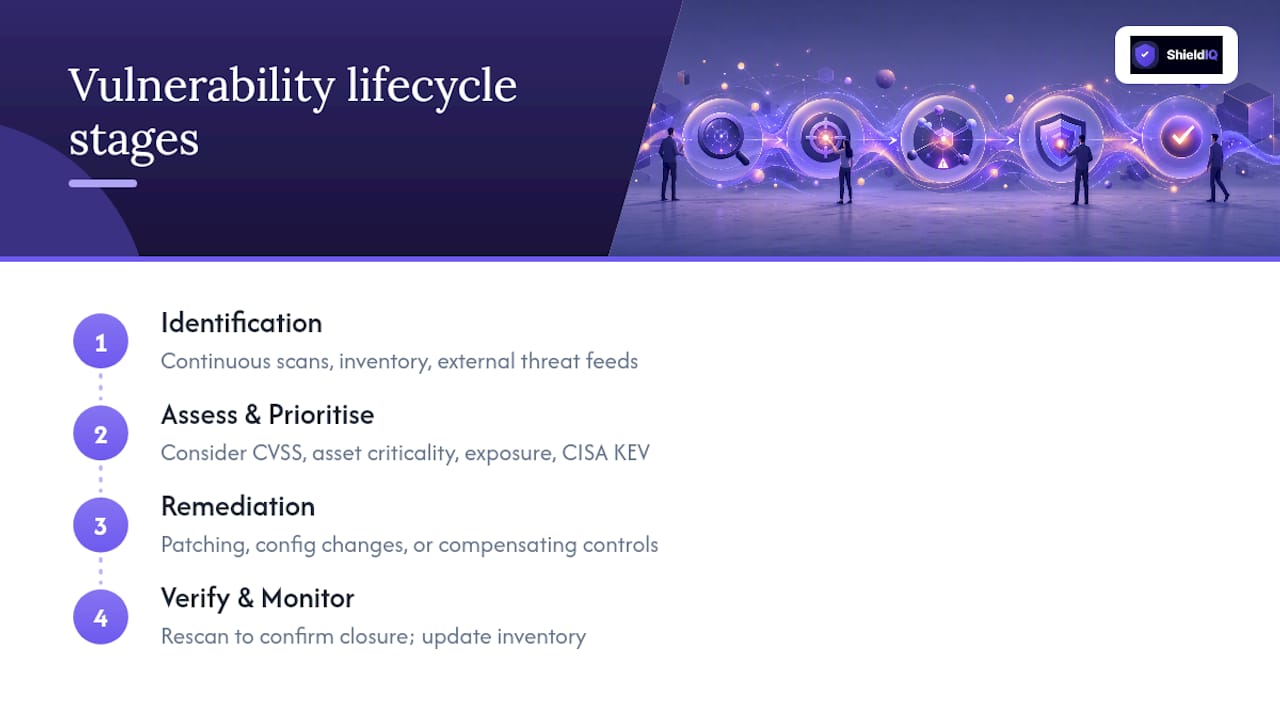
- Lifecycle description (identify, assess, remediate, verify)
- Remediation timelines by severity
- Exception and risk-acceptance process
- Metrics and reporting cadence
- References to recognised standards
Anchor those references to established guidance. The NCSC's vulnerability management collection, CISA's directive-driven remediation model, and the CIS Controls v8.1 template all give you defensible language auditors already recognise.
Key Takeaways
A vulnerability management policy only works when it pairs a documented lifecycle with named owners, fixed remediation SLAs, and evidence retention that survives an audit.
| Point | Details |
|---|---|
| Start with the skeleton | Purpose, scope, owner, lifecycle, SLAs, exceptions, metrics, and standards references are the non-negotiable headings. |
| Prioritise by context, not CVSS alone | Weigh asset criticality, exposure, and KEV listing status before setting remediation order. |
| Set defensible SLAs | Use models like CISA's 15/30-day windows for internet-facing critical and high severity findings. |
| Measure validation to verification | Track remediation time from confirmed detection to closed rescan to avoid distorted metrics. |
| Consider platform support for speed | ShieldIQ's AI drafting and automated assessments can generate an audit-ready draft and evidence trail faster than manual authoring. |
Table of Contents
- Vulnerability management policy skeleton you can copy
- How does the vulnerability lifecycle actually work?
- Who owns each part of the vulnerability management policy?
- What remediation timelines should you set?
- Which scanning practices belong in the procedure document?
- What metrics prove the policy is working?
- Copy-ready wording for your policy draft
- How do you roll this out in 90 days?
- How ShieldIQ speeds up policy drafting and audit readiness
- Why most vulnerability policies fail before remediation even starts
- Get your policy audit-ready without the manual drafting slog
- Frequently asked questions
- Sources
Vulnerability management policy skeleton you can copy
Structure your draft in this order, and fill each heading with two or three sentences before moving to the next.
- Purpose and objectives. State why the policy exists: to reduce exploitable risk across the estate and satisfy regulatory or contractual obligations such as ISO 27001 or NIS2.
- Scope. Name what's covered: on-premises infrastructure, cloud workloads, endpoints, and third-party or vendor-managed systems.
- Policy owner and approval authority. Identify who owns the document (typically a CISO or delegated security lead) and who signs off changes.
- Policy statements. One paragraph each on scanning frequency, prioritisation logic, remediation timelines, and the exception process.
- Definitions and references. A short glossary plus citations to CIS, NCSC, or CISA guidance.
This structure mirrors what most accepted industry templates already use, which makes it easier to defend during an audit conversation.
How does the vulnerability lifecycle actually work?
A policy only earns its keep once the lifecycle behind it runs on autopilot. Break it into four operational stages.
Identification relies on continuous rather than periodic scanning. Combine automated vulnerability scans, an accurate asset inventory, and external threat intelligence feeds so nothing new joins the network unnoticed. The NCSC's guidance treats this as a continuous discipline, not a monthly checkbox.
Assessment and prioritisation should never rely on raw CVSS scores alone. Factor in asset criticality, exposure (internet-facing versus internal), and whether the flaw appears on CISA's Known Exploited Vulnerabilities list. A medium-severity CVSS score on an internet-facing payment server deserves faster action than a critical score on an isolated test machine.
Remediation covers patching, configuration changes, or compensating controls when a patch isn't yet available. Where remediation can't happen within your SLA, the exception process kicks in, requiring documented risk acceptance from an accountable owner.
Verification and monitoring close the loop: rescan after every fix to confirm closure, and feed results back into your asset inventory.
Pro Tip: Measure remediation time from the validation date (when the flaw is confirmed) to the verification date (when a rescan proves it's closed), not from initial detection. This avoids the measurement drift that creeps in when patch releases or vendor delays distort your numbers.
Who owns each part of the vulnerability management policy?
Accountability collapses without named roles. Build the governance layer around four positions.
- Policy owner (CISO or delegated security lead): approves the policy, sets SLA thresholds, and reviews exceptions.
- IT and security operations: run scans, triage findings, and coordinate patch deployment with change management.
- Service or asset owners: remediate vulnerabilities on systems they control, or formally request an exception with justification.
- Executive sponsor or security committee: receives monthly or quarterly reporting and resolves escalations when remediation stalls.
Escalation needs teeth. If a critical vulnerability on an internet-facing asset breaches its SLA, the policy should trigger automatic escalation to the executive sponsor within a fixed number of days, not an informal nudge in a group chat.
What remediation timelines should you set?
Government directives offer a useful starting reference. CISA's Binding Operational Directive 19-02 historically required federal agencies to remediate critical vulnerabilities on internet-accessible systems within 15 days and high-severity ones within 30. Private-sector policies can borrow that structure while adjusting windows to reflect their own exposure.
| Severity | Suggested remediation window | Escalation trigger |
|---|---|---|
| Critical (internet-facing) | 15 days | Immediate notice to policy owner if breached |
| Critical (internal only) | 30 days | Weekly status to security committee |
| High | 30 days | Monthly review |
| Medium | 90 days | Quarterly review |
| Low | Next patch cycle | Tracked, not escalated |
Shorten these windows for anything internet-facing or holding regulated data, and lengthen them only where compensating controls genuinely reduce exploitability. Record every remediation timestamp against its validation date so SLA compliance is measurable, not anecdotal.
Which scanning practices belong in the procedure document?
Your policy should specify scan types, not just say "we scan regularly."
- Run external scans weekly against internet-facing assets and internal scans at least monthly across the internal network.
- Use authenticated scans wherever credentials allow. They surface far more accurate findings and cut false positives that waste remediation time.
- If you process card data, confirm whether an Approved Scanning Vendor (ASV) is required for your cardholder data environment, and qualify your scanner accordingly.
- Integrate scan output directly into your ticketing system, and align remediation windows with existing patch management and change windows so fixes don't stall waiting for a change approval slot.
What metrics prove the policy is working?
Auditors and executives both want evidence, not assurances. Mandate these as minimum reporting requirements.
- Time to remediate, broken out by severity tier, measured from validation to verification.
- Percentage of assets scanned against your total inventory, to catch scan coverage gaps.
- Open critical vulnerability count, tracked as a trend line, not a single snapshot.
- Retention of scan reports and remediation evidence for at least twelve months to support audit reviews.
- Reporting cadence: monthly to operational teams, quarterly to the security committee or board.
Copy-ready wording for your policy draft
A working header might read: "Policy owner: Head of Information Security. Effective date:. Scope: all production infrastructure, cloud services and vendor-managed systems processing company data."
From there, build out three or four policy statements:
- "All internet-facing assets are scanned externally on a weekly basis; internal assets are scanned monthly."
- "Vulnerabilities are prioritised using asset criticality, exposure, and inclusion on CISA's Known Exploited Vulnerabilities catalogue."
- "Critical vulnerabilities on internet-facing systems are remediated within 15 days; exceptions require documented risk acceptance from the policy owner."
Close with a short definitions block: CVE (a unique identifier for a publicly disclosed flaw), CVSS (a severity scoring framework), KEV (CISA's catalogue of vulnerabilities under active exploitation), and ASV (a vendor certified to run external scans against cardholder data environments).
How do you roll this out in 90 days?
- Weeks 1 to 2: Run a baseline scan across your full estate and reconcile results against your asset inventory.
- Weeks 3 to 4: Assign a policy owner, confirm service owners, and draft SLA thresholds by severity.
- Weeks 5 to 8: Configure scanners, connect output to your ticketing system, and pilot the workflow on one business unit.
- Weeks 9 to 12: Validate remediation timing, document your first exceptions, and deliver the first metrics report to leadership.
How ShieldIQ speeds up policy drafting and audit readiness
Drafting a compliant policy from scratch, then proving it's followed, eats weeks most security teams don't have. ShieldIQ's AI-driven policy drafting generates a first version of the skeleton above in minutes, and its automated assessments map your current controls against GDPR, NIS2, ISO 27001, and CIS Controls with scoring and gap analysis attached.
- Centralised evidence management keeps scan reports and remediation records audit-ready without spreadsheets.
- Gap analysis flags missing policy elements before an auditor does.
Pro Tip: Use platform support to get the skeleton audit-ready fast, but keep internal ownership of exception decisions. No tool should approve risk acceptance on your behalf.
Why most vulnerability policies fail before remediation even starts
Most policies I've seen fail for a boring reason: they read like compliance documents instead of operating manuals. They name a standard, gesture at "regular scanning," and stop there, leaving the actual remediation SLA vague enough that nobody's ever technically late.
The conventional advice treats CVSS scores as the whole story. It isn't. A 9.8 severity flaw on an air-gapped test server is not the same risk as a 6.5 on a customer-facing login page, and any policy that doesn't say so explicitly will get outpaced by whoever wrote theirs around exposure and asset criticality instead.

What the reader should prioritise first isn't the scanning tool or the reporting dashboard. It's the escalation trigger. A policy without a hard, named consequence for a missed SLA is a wish list, not a control. Get the owner, the timeline, and the escalation path locked down before you spend another hour tuning scanner settings. Everything else, including the metrics and the audit evidence, follows naturally once accountability is unambiguous.
Get your policy audit-ready without the manual drafting slog
Building the skeleton above by hand, then chasing evidence across spreadsheets every audit cycle, is where most internal teams lose momentum. ShieldIQ removes that friction: its AI-driven policy drafting produces a compliant vulnerability management policy aligned to CIS, NIS2, and ISO 27001 in minutes, and its automated assessments keep scoring and gap analysis current without a dedicated security team.
If you'd rather have expert hands on the first draft, ShieldIQ's consulting and vCISO services can build the policy and remediation workflow alongside you. Either way, start by checking where your current controls stand against ISO 27001 or NIS2 requirements, then request a platform demo to see the drafting and evidence tools in action.
Frequently asked questions
What's the difference between a vulnerability management policy and a patch management policy? A vulnerability management policy governs the full lifecycle, identification through verification, while patch management covers only the remediation mechanics of applying fixes. Most organisations reference patch management as a supporting procedure inside the wider policy.
How often should a vulnerability management policy be reviewed? Review the policy annually at minimum, and immediately after a significant incident, a new regulatory obligation, or a material change to your infrastructure footprint.
What happens when a critical vulnerability can't be patched within the SLA? The exception process takes over: the service owner documents the reason, proposes compensating controls, and a named approver formally accepts the residual risk, with a review date attached.
Does a vulnerability management policy need to cover third-party or vendor systems? Yes, if those systems touch your data or network. Extend scanning scope and remediation obligations to vendor-managed assets through contractual clauses where you can't scan directly.
How does this policy link to incident response? An unpatched vulnerability that gets exploited becomes an incident. The policy should reference your incident response plan directly, so a missed SLA on a critical flaw automatically triggers incident response involvement rather than sitting in a backlog.
Sources
- Vulnerability management | Guidance
- BOD 19-02: Vulnerability remediation requirements (CISA)
- CIS Controls v8.1 vulnerability management policy template