SMEs: Business Impact Analysis in 4–8 Weeks, ISO Aligned, Less Upkeep
A business impact analysis identifies which of your organisation's activities would cause the most damage if disrupted, and how quickly. It produces a prioritised register of critical functions, recovery time objectives (RTO), recovery point objectives (RPO), and maximum tolerable periods of disruption (MTPD). A senior sponsor, usually an operations director or CISO, should own it, and an SME can expect a first pass to take several weeks.
TL;DR:
- A business impact analysis must accurately quantify impact timing and severity across financial, regulatory, reputational, customer, and operational dimensions to inform recovery priorities.
- RTO should be set well below MTPD, typically 16 to 18 hours when MTPD is 24 hours, to provide a safety margin and realistic recovery expectations.
- Validating impact findings directly with process owners ensures data accuracy and prevents reliance on incomplete or inaccurate questionnaire responses.
- Dependency mapping should include roles, systems, vendors, and alternative options to identify single points of failure that could impair recovery efforts.
- Using an automated platform streamlines ongoing BIA maintenance, reduces manual effort, and supports continuous improvement for frameworks like ISO 22301, ISO 27001, and DORA.
Table of Contents
- What does a business impact analysis cover?
- Why does a business impact analysis matter for continuity and compliance?
- How do you conduct a business impact analysis step by step?
- What do RTO, RPO and MTPD actually mean?
- How do you map dependencies and spot single points of failure?
- How should you report and maintain a business impact analysis?
- How does an SME-focused GRC platform reduce BIA maintenance effort?
- What do continuity practitioners get wrong most often?
- ShieldIQ: a practical way to run and evidence your BIA
- Sources
What does a business impact analysis cover?
A business impact analysis measures consequence: what happens if a function stops, and for how long before that becomes unacceptable. A risk assessment measures likelihood: how probable is a given threat, and how severe is it. The two disciplines feed each other, but they answer different questions, and confusing them is one of the most common errors in continuity planning.
A properly scoped BIA quantifies disruption across several dimensions at once:
- Financial impact, including lost revenue, contractual penalties, and recovery costs
- Regulatory exposure, particularly reporting deadlines and licence conditions
- Reputational damage among customers, partners, and markets
- Customer impact, from service unavailability to data loss
- Operational knock-on effects across dependent processes
ISO/TS 22317 remains the accepted technical specification for structuring this work, and it sits alongside ISO 22301 as the reference point most auditors expect you to know.
Why does a business impact analysis matter for continuity and compliance?
A BIA is not a paperwork exercise. It tells you where to spend your recovery budget, and it stops you from over-protecting activities that barely matter and under-protecting the ones that do.
The outputs feed directly into practical decisions:
- Recovery strategy investment, from backup infrastructure to alternative sites and staffing
- Prioritisation when multiple systems fail simultaneously, so recovery teams know what to fix first
- Evidence for ISO 22301 certification, which requires a systematic process to assess business impact under clause 8.3, a point BCMStack's practitioner guide to BIA methodology sets out clearly
- Regulatory readiness for financial services firms working towards DORA, where resilience testing depends on accurate impact data
NIST goes further, recommending that BIA outputs feed enterprise risk management and cybersecurity prioritisation directly, not sit in a folder waiting for the next audit. That's the point of doing this properly: a well-run BIA starts informing real decisions, such as which system gets the next infrastructure spend, within weeks of the first workshop, according to NIST's guidance on using BIA to inform risk prioritisation.
How do you conduct a business impact analysis step by step?
Running a defensible BIA follows a consistent sequence, whether you're doing it for a ten-person consultancy or a regulated financial firm.
- Plan the exercise. Define scope (which business units, which processes), appoint an executive sponsor, and pick a methodology and timeline before you contact anyone.
- Gather data. Run structured interviews, distribute questionnaires, and build a process inventory. Don't rely on surveys alone; unvalidated responses are the single most common source of unrealistic RTOs, as e|Resilient's step-by-step BIA guide warns.
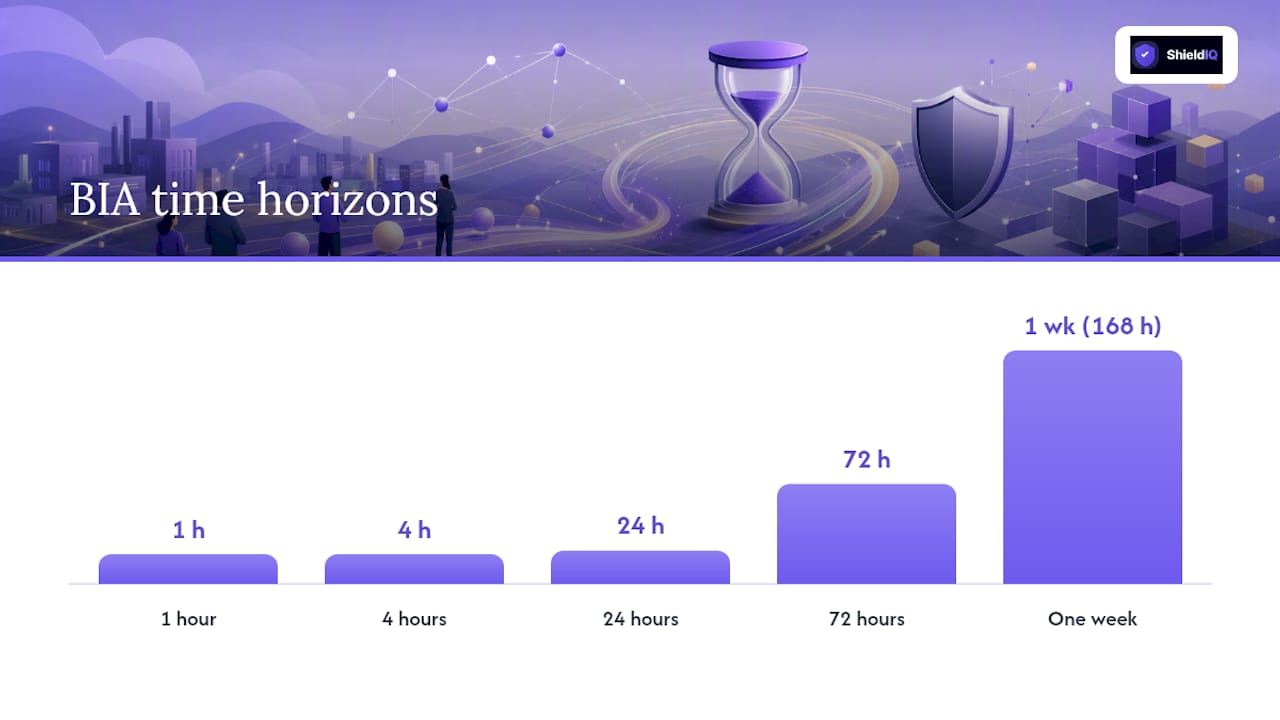
- Analyse impact over time. Ask what happens at 1 hour, 4 hours, 24 hours, 72 hours, one week, and two weeks of disruption. Plotting this produces an impact-over-time curve, the methodological core of a credible BIA.
- Build the impact matrix. Cross-reference each critical activity against the five impact dimensions at each time horizon.
- Derive recovery metrics. Work out RTO, RPO, MTPD, and minimum business continuity objective (MBCO) for each activity, based on where impact crosses from tolerable to critical on the curve.
- Map dependencies. Identify the people, systems, vendors, and locations each activity relies on.
- Validate with process owners. Cross-check every finding with the people who actually run the process, not just the person who filled in the questionnaire.
- Aggregate into a prioritised register. Rank activities by criticality and feed the results into recovery strategy decisions.
Pro Tip: Run validation interviews separately from the initial data-gathering survey. Process owners tend to be more candid, and more accurate, in a follow-up conversation than in the first form they filled out under time pressure.
Most SMEs complete this cycle in four to eight weeks using spreadsheets, according to AlertMedia's guide to conducting a BIA, before considering whether ongoing maintenance justifies a dedicated platform.
What do RTO, RPO and MTPD actually mean?
These three metrics get confused constantly, and the confusion causes real damage when a disruption hits.
- RTO (Recovery Time Objective): the maximum acceptable time to restore a function after disruption.
- RPO (Recovery Point Objective): the maximum acceptable data loss, measured in time since the last good backup.
- MTPD (Maximum Tolerable Period of Disruption): the absolute outer limit before consequences become unrecoverable for the business.
- MBCO (Minimum Business Continuity Objective): the minimum service level acceptable during recovery, often below normal operations.
MTPD comes directly off the impact-over-time curve: it's the horizon where the impact line crosses into "critical" territory. RTO must sit inside that limit, never equal to it. Setting RTO equal to MTPD leaves no safety margin at all, a point Arthur Cox's commentary on DORA and operational resilience in Ireland makes explicitly. MTPD is a business judgement, not an IT setting, and RTO is the commitment your organisation makes against it.
If your MTPD is 24 hours, don't set RTO at 24 hours. Set it at 16 to 18, so a slow recovery still lands inside tolerance.*
How do you map dependencies and spot single points of failure?

Every critical activity in your register depends on something else: a person with specific knowledge, a system, a supplier, a physical location. Miss one, and your RTO is fiction.
For each dependency, capture:
- The role or team responsible, and whether a backup person exists
- The system or application it relies on, with its own recovery capability
- The vendor and its contracted SLA, not the SLA you assume it has
- Any viable alternative or workaround if the primary dependency fails
Dependency data directly constrains what RTO is achievable. If your critical payment process depends on a vendor with a 48 hour SLA, you cannot commit to a 12 hour RTO no matter what the business wants. Validate every vendor dependency against its actual contract terms, not the sales pitch, and check what your supplier contracts actually specify for recovery commitments before you rely on them.
How should you report and maintain a business impact analysis?
A BIA report needs an executive summary, the prioritised criticality register, dependency maps, and the recovery decisions the analysis supports. Anything less, and an auditor will ask where the evidence trail is.
Structure matters as much as content:
- Executive sponsorship signs off the final register, not just the project team
- Process owners formally validate their own sections before publication
- A full refresh happens annually as a baseline
- Change-triggered reviews happen whenever a critical system, vendor, or process changes materially
ISO 22301 treats this as a systematic, ongoing process rather than a one-off document, and that's exactly how auditors will read it. A BIA finished in March and never touched again is a liability, not an asset, by the time your next audit comes round.
How does an SME-focused GRC platform reduce BIA maintenance effort?
Spreadsheets work for a first BIA. They struggle once you're running annual refreshes, chasing questionnaire responses across departments, and rebuilding dependency maps by hand every time a vendor changes.
A platform designed for SMEs can automate questionnaire distribution, capture evidence centrally, maintain a live dependency register, and surface dashboards showing what's overdue for review. That turns audit-readiness into something continuous rather than a scramble every twelve months, which matters most once you're managing multiple frameworks alongside your BIA.
What do continuity practitioners get wrong most often?
Most SME business impact analyses stall not from lack of effort, but from treating the first questionnaire response as fact. Data quality collapses when nobody follows up with a second conversation. The fastest way to build confidence in your outputs is deceptively simple: validate every critical RTO with the process owner directly, not through a form. Projects that skip this step consistently produce recovery targets nobody can actually meet.
— Matthew Lemon
ShieldIQ: a practical way to run and evidence your BIA
Once your BIA moves past the first spreadsheet pass, the maintenance burden is the real cost, not the initial workshops. ShieldIQ automates the parts that eat the most time: questionnaire distribution to process owners, centralised evidence capture, a live dependency register, and dashboards that flag when a review is due before an auditor asks.
If you're managing a BIA alongside frameworks like ISO 22301, ISO 27001, or DORA, running them separately in spreadsheets multiplies the admin every time one changes. A platform built for SMEs keeps them linked, so a change to one dependency register updates everywhere it matters. Switch when your annual refresh starts eating more time than the original project did, not before. Start with a free assessment on ShieldIQ to see how much of that maintenance can run itself, or book a consulting session if you'd rather have a vCISO run the first cycle with you.