Control mapping: a practical guide for compliance teams

Control mapping is the practice of aligning one set of implementable controls to satisfy requirements from multiple regulatory frameworks at once, so a single MFA policy can serve as evidence for ISO 27001, GDPR and NIS2 simultaneously. Done well, it cuts duplicated evidence collection, speeds up audit preparation, and gives you consistent risk coverage across ISO 27001, GDPR, NIS2, DORA, SOC 2 and the EU AI Act. Machine-readable standards like NIST's OSCAL model now make that mapping auditable, not just aspirational.
Key Takeaways
Control mapping works because it turns one tested control into evidence for multiple regulators, cutting duplicated work while keeping risk coverage consistent across frameworks.
| Point | Details |
|---|---|
| Define terms first | Separate control, common control and control library before starting any mapping work. |
| Rationalise, don't accumulate | Merge near-duplicate controls to avoid control bloating as frameworks are added. |
| Use OSCAL for scale | Machine-readable mapping formats support automated gap and change-impact analysis. |
| Map to the highest standard | Configure shared controls to satisfy the strictest applicable framework requirement. |
| ShieldIQ centralises the library | ShieldIQ offers an AI-powered cross-framework control library with evidence automation for GDPR, NIS2, ISO 27001, DORA, SOC 2 and the EU AI Act. |
Table of Contents
- What do control mapping and its core terms actually mean?
- What are the main benefits of mapping controls across frameworks?
- What goes wrong when teams map controls badly?
- How does control mapping work step by step?
- What does a finished control library and mapping matrix look like?
- How does automation change control mapping at scale?
- What can the Unified Control Framework teach you about mapping?
- How do you keep control mappings accurate over time?
- How ShieldIQ supports control mapping for SMEs
- Frequently asked questions
- Sources
What do control mapping and its core terms actually mean?
Before you build anything, the vocabulary needs to be nailed down. Compliance teams waste weeks arguing past each other because "control" means something slightly different in every meeting.
- Control: a specific safeguard, such as "enforce MFA on all admin accounts", with an owner and a testable outcome.
- Common control: a control that satisfies requirements from two or more frameworks without modification, for example an access review process referenced by both ISO 27001 and SOC 2.
- Control library: the master repository of your organisation's controls, each tagged with the frameworks and clauses it satisfies.
- Control mapping: the act of linking a control to the specific requirement(s) it addresses across one or more standards.
- Control-to-requirement mapping: the documented, granular link between a single control and a single clause, usually stored in a matrix.
- Acceptance criteria and owner: the pass/fail test for a control, and the named person accountable for it.
A policy control ("we have an access control policy") is not the same as a technical control ("MFA is enforced for 100% of privileged accounts"). A common control differs from a framework-specific requirement because it is written to be reusable, not tied to one regulator's phrasing.
What are the main benefits of mapping controls across frameworks?
Once your library exists, the payoff shows up fast, usually within the first audit cycle.
- Less duplicated evidence: one screenshot, one policy, one test result can satisfy several auditors instead of being recreated per framework.
- Faster audits: assessors work from a matrix rather than chasing scattered spreadsheets, which shortens fieldwork.
- Consistent risk coverage: gaps become visible immediately, rather than being discovered separately under each regulation.
- Better reporting to the board: a single dashboard shows compliance posture across GDPR, NIS2, DORA and ISO 27001 without translation work.
- Lower operational cost: fewer people re-collecting the same proof, repeatedly, for different regulators.
Statistic callout: Guidance from the CIS Controls mapping resource identifies recurring overlap domains, including access control, incident response, change management, vulnerability management and third-party risk, meaning most frameworks are already asking you similar questions in different language.
Beyond the audit-cycle savings, a mature control library is itself a signal. Regulators and customers increasingly read a well-mapped compliance programme as a proxy for operational maturity, not just paperwork.
What goes wrong when teams map controls badly?
Most mapping projects fail quietly, not dramatically. The controls exist, the matrix exists, but nobody trusts either.
- Scope creep: teams start with two frameworks and drift into mapping five, losing focus on evidence quality.
- Control bloating: instead of rationalising, teams stack near-duplicate controls, ending up with a library larger and messier than the frameworks it replaced.
- Inconsistent ownership: a control with two "owners" effectively has none when an auditor asks a hard question.
- Stale evidence: screenshots and test results age past their usefulness, especially for annually reviewed controls.
- Spreadsheet limits: manual tracking works for one framework; it collapses under five.
Pro Tip: Before adding a new control, check whether an existing one, rewritten slightly, already covers the requirement. Rationalisation, not addition, is the discipline that prevents control bloating.
Some requirements resist simple mapping altogether. Prescriptive clauses in PCI DSS or the EU AI Act's risk-tiering rules often force you to configure a control to a specific, higher standard rather than just tagging it as "covered."

How does control mapping work step by step?
A control mapping exercise runs cleanest as an eight-stage sequence. Skipping steps is what produces the bloated, untrustworthy libraries described above.
- Scope and framework inventory. List every framework in play (GDPR, NIS2, DORA, ISO 27001, SOC 2, EU AI Act) and the clauses relevant to your organisation. Deciding which frameworks actually apply to your business belongs here, before any control work starts.
- Catalogue existing controls and evidence. Pull together what already exists, however informal, rather than starting from a blank page.
- Map requirements to candidate controls. Use syntactic (wording match), semantic (meaning match) and functional (outcome match) relationships, the same taxonomy OSCAL formalises for machine-readable mapping.
- Rationalise into unified controls. Merge near-duplicates into a single, reusable control per objective.
- Define acceptance criteria and owners. Every control needs a named owner and a testable pass condition.
- Implement and test. Configure the control to the highest applicable standard among the frameworks it serves; if ISO 27001 and NIS2 both touch logging retention, build to whichever demands more.
- Capture evidence and configure reuse rules. Tag evidence so it automatically maps to every satisfied requirement, not just the one it was collected for.
- Audit and iterate. Test the mapping against a real or mock audit, then refine.
At each stage, keep a simple artefact trail: who owns it, what evidence type is expected, and what "pass" looks like. That trail is what turns a mapping exercise into something an auditor can actually rely on.
What does a finished control library and mapping matrix look like?
A control library record needs surprisingly few fields to be useful: a unique ID, a plain-language description, an owner, links to current evidence, the requirements it maps to, acceptance criteria, and the date it was last tested.
A small illustrative matrix shows how one control can serve several frameworks at once:
| Control | ISO 27001 | NIST CSF | SOC 2 | GDPR |
|---|---|---|---|---|
| MFA on privileged accounts | Access control clause | Protect function | Logical access criterion | Security of processing |
| Vendor risk assessment | Supplier relationships clause | Supply chain function | Vendor management criterion | Processor obligations |
| Incident response plan | Incident management clause | Respond function | Availability criterion | Breach notification duty |
| Quarterly access review | Access control clause | Protect function | Logical access criterion | Data minimisation principle |
Increasingly, this matrix does not live only in a spreadsheet. Machine-readable formats such as OSCAL (XML, JSON or YAML) let you express these relationships precisely enough for automated gap analysis, which is worth asking about if you are evaluating control mapping software built for cross-framework work.
How does automation change control mapping at scale?
Spreadsheets work for one framework. They start to fail somewhere around the third, once cross-references multiply faster than anyone can track by hand. Automation earns its keep here.
- Pre-mapped controls: platforms ship with frameworks already cross-referenced, so you are not starting from zero.
- Automated evidence collection: integrations pull logs and configurations directly, instead of relying on manual screenshots.
- Change-impact analysis: when a framework updates, the platform flags every control affected, rather than leaving you to search manually.
- Continuous monitoring: control status updates in real time instead of at the next scheduled review.
- Auditor-ready exports: a single click produces a framework-specific report from the same underlying evidence.
When comparing platforms, check for: coverage of the frameworks actually in your scope (GDPR, NIS2, ISO 27001, DORA, EU AI Act, SOC 2); OSCAL import or export, or at minimum an open API; genuine evidence automation rather than manual upload; role-based ownership; audit-ready reporting; and a pricing model that scales with modules and frameworks rather than punishing growth.
A sensible migration path is to pilot two domains first, prove the evidence automation actually works, then expand framework by framework rather than attempting a full cutover in one go.

What can the Unified Control Framework teach you about mapping?
Academic research on the Unified Control Framework (UCF) offers a useful discipline check for anyone building a control library: smaller and better mapped beats larger and looser.
The UCF research mapped a compact library of roughly 41 to 42 controls against most requirements in the Colorado AI Act, demonstrating that a parsimonious set of well-defined controls can cover complex, fast-moving regulation without duplicating mappings for every new rule.
For practitioners, the implication is direct: when you fold a new obligation, such as EU AI Act requirements, into your existing library, resist the urge to write new controls first. Check whether an existing, rationalised control already satisfies the intent. That habit is what keeps a control library governing AI risk and traditional security risk from the same, manageable set, rather than sprawling into two disconnected systems. Readers wanting the formal mapping mechanics should look at OSCAL's relationship types directly.
How do you keep control mappings accurate over time?
A mapping exercise that is never revisited decays within a year. Frameworks update, staff change, and evidence goes stale quietly.
- Continuous monitoring: automated checks on critical controls, run daily where the risk justifies it.
- Evidence refresh cycles: a monthly cadence for evidence that changes often, such as vulnerability scan results.
- Change-impact analysis: whenever a framework updates (NIS2 guidance, DORA technical standards), re-run the mapping for affected controls.
- Owner review schedule: quarterly mapping reviews, with a full annual audit across the entire library.
Audit readiness comes from being able to generate a framework-specific view on demand, with every control traceable back to its evidence and test date.
When should you start mapping, and what trips teams up?
Start mapping when you are preparing for a second regulatory standard, not the first. That is the point where duplicated effort becomes visible enough to justify the work. The error I see most often is aggregating requirements without rationalising them, which produces control bloating rather than a genuine unified library. For executives: mapping is an investment that reduces long-term compliance cost and audit friction.
How ShieldIQ supports control mapping for SMEs
ShieldIQ is built around exactly the workflow this guide describes: an AI-powered GRC platform that gives EU-based SMEs a cross-framework control library instead of five separate spreadsheets.
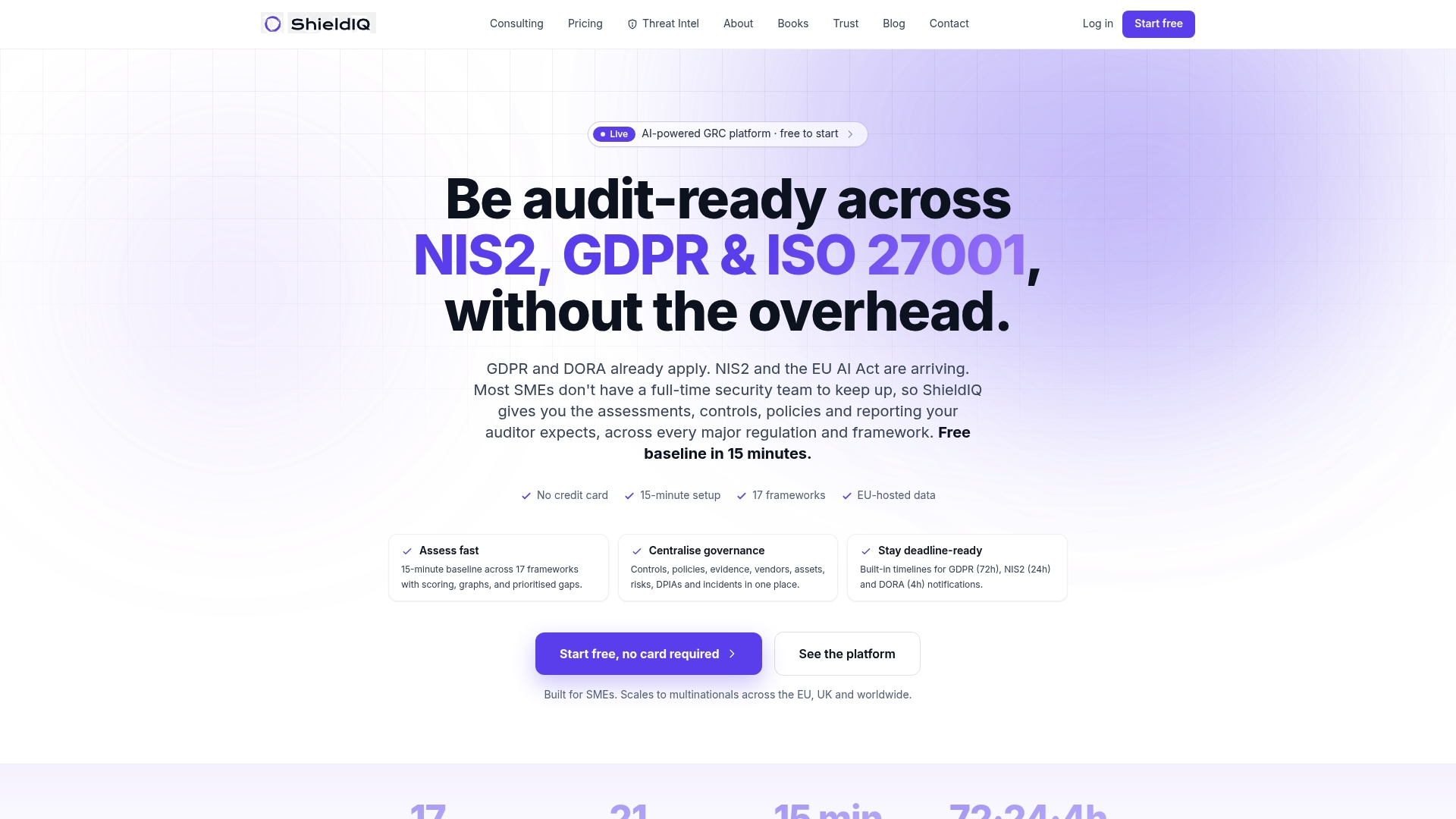
Coverage spans GDPR, NIS2, ISO 27001, DORA, SOC 2 and the EU AI Act from one dashboard, with automated assessments, gap analysis and evidence management doing the work that used to require a consultant. Against the selection checklist above, ShieldIQ maps directly: cross-framework coverage, evidence automation, role-based ownership, and audit-ready exports built in, without needing a dedicated security team. If you are weighing up DORA-specific compliance needs or preparing for ISO 27001 certification alongside other obligations, the same control library handles both. Start with a rapid assessment on the critical infrastructure security framework to see where your existing controls already overlap, and where the gaps genuinely sit.
Frequently asked questions
What is the difference between control mapping and a common control framework? Control mapping is the activity of linking controls to requirements; a common control framework (or unified control framework) is the resulting structure, an organised library where each control is already tagged against every framework it satisfies.
Does control mapping replace the need for framework-specific audits? No. It reduces duplicated evidence work, but each regulator or certification body, whether for ISO 27001 or SOC 2, still runs its own audit against its own clauses using the mapped evidence.
How often should a control mapping matrix be reviewed? A practical cadence is quarterly reviews for the mapping itself, with continuous or monthly evidence refresh for higher-risk controls, and a full annual audit of the entire library.
Can control mapping cover the EU AI Act alongside security frameworks like ISO 27001? Yes, and research on the Unified Control Framework specifically demonstrates this, showing a compact control set can address AI-specific obligations and traditional security requirements without duplicating effort.
Sources
- Unified Control Framework for AI governance (arXiv)
- OSCAL control mapping model (NIST)
- Mapping and compliance with the CIS Controls (CIS)
- ISO/IEC 27001 (ISO)