GDPR compliance checklist for EU organisations (2026)
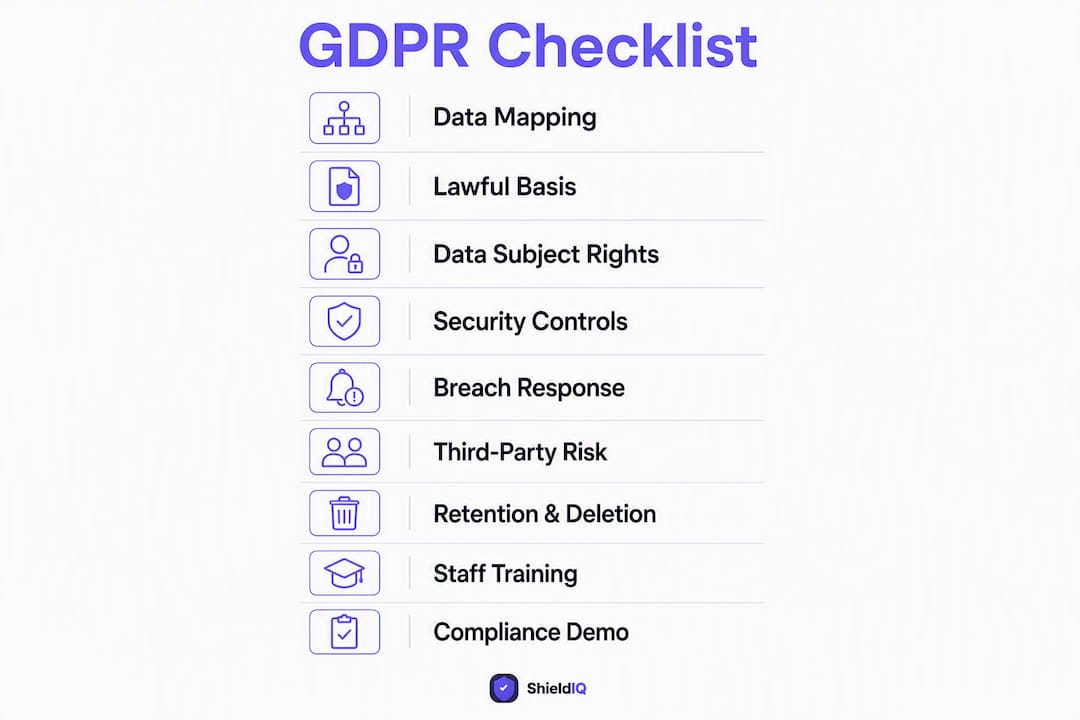
Use this checklist to become audit-ready for EU GDPR: map your data, document lawful bases, secure processing, and keep live evidence that regulators can inspect at any time. The General Data Protection Regulation (Regulation (EU) 2016/679) applies to every organisation that processes personal data of EU residents, regardless of where that organisation is based. If that describes your business, the checklist below is your operational starting point.
Your top six actions, prioritised:
- Data mapping and RoPA (Article 30): build a live record of every processing activity, owner, purpose, and lawful basis. This is the foundation everything else depends on.
- Lawful bases: document the legal ground for each processing activity before you collect data, not after.
- Privacy notices: publish clear, accurate notices covering all Article 13/14 requirements and keep them version-controlled.
- Security controls and DPIAs: implement Article 32 technical and organisational measures; run a Data Protection Impact Assessment before any high-risk processing begins.
- Breach response plan: have a written playbook and know the 72-hour notification rule before you need it.
- Vendor Data Processing Agreements (DPAs): every processor you use must have a signed DPA in place.
Who acts on what, and when:
| Timeframe | Priority action | Owner |
|---|---|---|
| First days | Complete data mapping; start RoPA | DPO / Compliance lead |
| First days | Audit existing vendor contracts for DPAs | Legal / Procurement |
| Initial weeks | Finalise lawful bases; update privacy notices | Legal / DPO |
| Initial weeks | Draft breach response playbook | CISO / IT / DPO |
| First months | Run DPIAs for high-risk processing | DPO / Product / IT |
| First months | Deploy Article 32 security controls; train staff | CISO / IT / HR |
| Ongoing | Monitor, update RoPA, review vendors, retrain | DPO / Compliance |
Table of Contents
- What does a complete GDPR compliance checklist cover?
- How to build a live record of processing activities
- How to identify the correct lawful basis and keep privacy notices accurate
- How to handle data subject rights requests efficiently
- What security controls does Article 32 require, and when do you need a DPIA?
- How to run a breach response and meet the 72-hour notification rule
- How to manage third-party risk: DPAs, due diligence, and ongoing monitoring
- International transfers and transfer risk assessments
- How to build a retention schedule and evidence secure deletion
- Staff training, awareness, and embedding privacy by design
- How to demonstrate compliance to EU supervisory authorities
- Realistic timelines and cost drivers for GDPR compliance
- How an automated GRC platform maps to this checklist
- Key takeaways
- The compliance gap most organisations do not see until it is too late
- ShieldIQ helps you stay audit-ready without a full-time compliance team
- Useful sources, templates, and regulator pages
What does a complete GDPR compliance checklist cover?
GDPR compliance spans fourteen interlocking areas, from data mapping through to ongoing staff training. The table below is your master reference. Use it to assign owners, estimate effort, and gather the evidence a supervisory authority will expect to see.
| Action | Responsible | Evidence to hold | Priority | Est. time | Cost drivers |
|---|---|---|---|---|---|
| Build and maintain RoPA (Article 30) | DPO / Compliance | RoPA export, data flow diagrams | Critical | 2–4 weeks | Discovery tooling, staff time |
| Document lawful bases for all processing | Legal / DPO | Lawful basis register, LIA records | Critical | 1–2 weeks | Legal review hours |
| Publish and version-control privacy notices | Legal / Marketing | Notice versions with publish dates | Critical | 1 week | Copywriting, legal sign-off |
| Implement consent management (where required) | IT / Marketing | Consent logs, CMP configuration | High | 2–3 weeks | CMP platform, dev effort |
| Establish DSAR intake and fulfilment process | DPO / Ops | DSAR case logs, timelines, search reports | Critical | 2–3 weeks | Workflow tooling, staff time |
| Run DPIAs for high-risk processing | DPO / Product | Completed DPIA documents with approvals | High | 1–3 weeks per DPIA | External legal, DPO time |
| Deploy Article 32 security controls | CISO / IT | Config screenshots, pen test reports, access logs | Critical | 4–12 weeks | Engineering, tooling |
| Write and test breach response playbook | CISO / DPO | Playbook, test records, breach register | Critical | 2–4 weeks | Staff time, legal review |
| Sign DPAs with all processors | Legal / Procurement | Signed DPA catalogue | Critical | 2–6 weeks | Legal drafting, vendor negotiation |
| Assess and document international transfers | Legal / DPO | SCCs, TIA records, adequacy notes | High | 2–4 weeks | Legal review |
| Build retention schedule and deletion process | DPO / IT / Ops | Retention schedule, deletion logs | High | 2–4 weeks | Engineering, tooling |
| Deliver role-based staff training | HR / DPO | Attendance logs, assessment scores | High | 2–4 weeks | Training platform, content |
| Appoint DPO (if required); document governance | Leadership / Legal | DPO appointment record, governance policy | Critical | 1–2 weeks | DPO salary or retainer |
Scaling note: a small EU controller with limited processing activities can work through the critical items in roughly eight to twelve weeks with a focused team. A larger processor handling sensitive data categories will typically need six months or more, particularly for security engineering and vendor remediation. Prioritise the "Critical" rows first; they are the items supervisory authorities check first in an investigation.
How to build a live record of processing activities
Data mapping is the first step in any GDPR programme, and for good reason: without a clear picture of what data you hold, where it lives, and who touches it, every other control is built on guesswork. Article 30 of the GDPR explicitly requires organisations with 250 or more employees to maintain a detailed RoPA. Smaller organisations are strongly advised to keep equivalent records to demonstrate accountability, and in practice most supervisory authorities expect them regardless of headcount.
Essential fields to capture in your RoPA:
- Name and contact details of the controller (and DPO, if appointed)
- Purpose of each processing activity
- Categories of data subjects and personal data
- Categories of recipients (internal teams, third-party processors, public authorities)
- Lawful basis for processing
- Transfers to third countries and the safeguards applied
- Retention periods (or the criteria used to determine them)
- Technical and organisational security measures
- Data flows: where data enters, where it is stored, and where it exits
The discovery phase is where most organisations underestimate the effort. You need to scan SaaS subscriptions, cloud storage buckets, databases, email archives, and endpoints. Shadow IT is a genuine risk: a marketing team's unapproved analytics tool can hold personal data that never appears in the official RoPA. Assign a data owner to each system and require them to confirm or update their entry whenever a system changes.
Pro Tip: Link each RoPA entry to live operational evidence rather than a static document. A screenshot of your encryption configuration, a current access control list, or a vendor's latest security certificate is far more credible to a regulator than a policy that says "we encrypt data." ShieldIQ's RoPA automation connects records directly to control evidence, so your RoPA reflects the current state of your systems, not last year's audit.

How to identify the correct lawful basis and keep privacy notices accurate
Every processing activity needs a documented lawful basis before it begins. The six bases under Article 6 are:
- Consent: freely given, specific, informed, and unambiguous. Appropriate for marketing communications and non-essential cookies, but not for employment processing or contractual services.
- Contract: processing necessary to perform a contract with the data subject, or to take pre-contractual steps at their request.
- Legal obligation: processing required to comply with EU or member state law.
- Vital interests: rare; applies where processing is necessary to protect someone's life.
- Public task: for public authorities or organisations exercising official authority.
- Legitimate interests: available to controllers where their interests or those of a third party are not overridden by the data subject's rights. Requires a Legitimate Interest Assessment (LIA).
Document your lawful basis decision for each processing activity in your RoPA and in a separate lawful basis register. If you rely on legitimate interests, the LIA must be written, retained, and reviewed whenever the processing changes. Consent records must be timestamped and tied to the specific notice version the data subject saw.
Privacy notice minimum content (Articles 12–14):
- Identity and contact details of the controller and DPO
- Purpose and lawful basis for each processing activity
- Categories of personal data collected
- Recipients or categories of recipients
- Details of any international transfers and safeguards
- Retention periods
- Data subject rights and how to exercise them
- Right to lodge a complaint with a supervisory authority
- Whether provision of data is a statutory or contractual requirement
- Existence of automated decision-making or profiling, with meaningful information about the logic involved
Version-control every notice with a publish date and keep prior versions archived. Your notice text must stay aligned with your RoPA: if you add a new processing activity, update both simultaneously. A notice that describes processing you no longer carry out, or omits processing you do, is a compliance failure in itself.
How to handle data subject rights requests efficiently
Data subjects have six core rights under the GDPR: access (DSAR), rectification, erasure, data portability, restriction of processing, and objection. Each right has its own conditions and exceptions, but the operational process for handling them follows a consistent pattern.
- Receive and log the request. Record the date received, the type of request, and the identity of the requester. The one-month response clock starts from the date of receipt.
- Verify identity. Request reasonable evidence of identity before disclosing or deleting data. Do not ask for more than is proportionate to the risk.
- Triage the request. Determine which right applies and whether any exemptions are relevant (e.g. legal professional privilege, third-party data, disproportionate effort for erasure).
- Search and compile. Run a documented search across all systems listed in your RoPA. Record which systems were searched, by whom, and on what date.
- Review and redact. Check the output for third-party personal data and redact before disclosure. Document the redaction decisions.
- Respond within one month. If the request is complex or you receive a high volume, you may extend by a further two months, but you must notify the data subject within the first month and explain the reason.
- Record the outcome. Log the response date, the action taken, and any exemptions applied. Retain this record for at least three years.
For portability requests, data must be provided in a structured, commonly used, machine-readable format (e.g. CSV or JSON). Portability applies only where the lawful basis is consent or contract, and only to data the subject provided directly.
For erasure requests, document any lawful grounds for refusal (e.g. legal obligation to retain, public interest, legal claims). A deletion log showing which systems were purged, and when, is the evidence auditors will ask for.
What security controls does Article 32 require, and when do you need a DPIA?
Article 32 requires controllers and processors to implement technical and organisational measures appropriate to the risk. The regulation does not prescribe a fixed list, but supervisory authorities consistently expect the following:
- Encryption at rest and in transit for all personal data, with documented key management procedures.
- Pseudonymisation where technically feasible, particularly for analytics and testing environments.
- Access controls: role-based access, least-privilege principles, multi-factor authentication for systems holding personal data.
- Logging and monitoring: audit logs for access to personal data, with log retention sufficient to support breach investigation.
- Regular testing: penetration testing, vulnerability scanning, and security reviews of systems processing personal data.
- Backup and recovery: tested backup procedures with documented recovery time objectives.
- Incident detection: tooling or processes to detect anomalous access or exfiltration attempts.
Evidence for each control should be operational, not aspirational. A configuration screenshot showing encryption enabled, an access control list showing who has read/write permissions, and a dated penetration test report carry far more weight than a policy document. Aligning these controls with ISO 27001 is an efficient route: many Article 32 requirements map directly to ISO 27001 Annex A controls, so a single evidence set can satisfy both frameworks.
When is a DPIA required?
A Data Protection Impact Assessment is mandatory before you begin any processing that is likely to result in a high risk to individuals. Triggers include:
- Systematic and extensive profiling with significant effects
- Large-scale processing of special category data (health, biometric, genetic, racial or ethnic origin, etc.)
- Systematic monitoring of publicly accessible areas
- New technologies or novel uses of existing data
- Processing that could result in denial of services or legal effects
Concise DPIA template fields:
- Description of the processing and its purposes
- Necessity and proportionality assessment
- Identification of risks to data subjects
- Risk rating (likelihood × severity)
- Mitigating measures proposed
- Residual risk assessment
- DPO consultation record
- Controller sign-off and date
If residual risk remains high after mitigation, you must consult your supervisory authority before proceeding. Keep completed DPIAs on file and review them whenever the processing changes materially.
How to run a breach response and meet the 72-hour notification rule
The GDPR requires controllers to notify the relevant supervisory authority of a personal data breach without undue delay and, where feasible, no later than 72 hours after becoming aware of it, unless the breach is unlikely to result in a risk to individuals. That 72-hour window is tight. Without a written playbook, teams waste the first hours deciding who is responsible.
Incident playbook essentials:
- Detection and initial triage: who receives the alert, how it is logged, and the immediate containment steps (isolate affected systems, revoke compromised credentials).
- Classification: assess the type of breach (confidentiality, integrity, availability), the categories and volume of data affected, and the likely risk to data subjects.
- Notification decision: document the decision on whether the breach meets the threshold for supervisory authority notification. If in doubt, notify.
- Supervisory authority notification: submit within 72 hours of awareness. Include the nature of the breach, categories and approximate number of data subjects and records affected, contact details of the DPO, likely consequences, and measures taken or proposed.
- Data subject notification: required where the breach is likely to result in a high risk to individuals. Must be in clear, plain language and describe the nature of the breach, the DPO contact, likely consequences, and steps taken.
- Containment, eradication, and recovery: document each step with timestamps.
- Lessons learned: a post-incident review within 30 days, with findings recorded and fed back into controls.
Evidence to maintain:
- A breach register recording every incident, its classification, the notification decision, and the outcome.
- Forensic logs and system event records supporting the timeline.
- Written rationale for any decision not to notify a supervisory authority.
- Copies of all notifications sent, with timestamps.
For a detailed playbook template, ShieldIQ's breach response guide walks through the first 72 hours step by step.
How to manage third-party risk: DPAs, due diligence, and ongoing monitoring
Every organisation that processes personal data on your behalf is a processor under the GDPR, and you are required to have a written Data Processing Agreement in place with each one. This applies to cloud providers, payroll processors, marketing platforms, analytics tools, and any other vendor that touches personal data.
Vendor onboarding checklist:
- Map all processors and the data flows between you and each one.
- Classify each vendor by data sensitivity (special category data, financial data, children's data) and business criticality.
- Perform a DPIA for high-risk processing chains before onboarding.
- Obtain and review the vendor's security documentation (ISO 27001 certificate, SOC 2 report, or equivalent).
- Sign a DPA before any personal data is shared.
Key DPA clauses to require:
- Scope and subject matter of processing
- Duration and nature of processing
- Categories of data subjects and personal data
- Instructions for processing (controller's documented instructions)
- Sub-processor restrictions and approval process
- Security measures (Article 32 obligations on the processor)
- Audit rights for the controller
- Breach notification obligations (processor must notify controller without undue delay)
- Deletion or return of data at contract end
Ongoing monitoring:
- Annual vendor questionnaires covering security posture, sub-processor changes, and incident history.
- Review of updated penetration test summaries or security certifications.
- Maintain a current sub-processor list for each major vendor.
- Trigger a review whenever a vendor announces a material change to its infrastructure, ownership, or data processing locations.
Prioritise vendors by the sensitivity of the data they process and the volume of data subjects involved. A payroll processor holding employee salary data warrants more scrutiny than a low-risk productivity tool.
International transfers and transfer risk assessments
Transferring personal data outside the EU or EEA requires a lawful transfer mechanism under Chapter V of the GDPR. The permitted routes are:
- Adequacy decisions: the European Commission has determined that the destination country provides an equivalent level of protection. No additional safeguards are required.
- Standard Contractual Clauses (SCCs): the 2021 EU SCCs are the most commonly used mechanism for transfers to non-adequate countries. They must be incorporated into contracts without modification.
- Binding Corporate Rules (BCRs): approved intra-group transfer mechanisms for multinational organisations. Require supervisory authority approval and are resource-intensive to establish.
- Approved codes of conduct or certification mechanisms: available but rarely used in practice.
- Derogations (Article 49): limited exceptions for explicit consent, contract performance, legal claims, vital interests, or public interest. Not suitable as a primary transfer mechanism for systematic transfers.
When to run a Transfer Impact Assessment (TIA):
A TIA is required when you rely on SCCs and the destination country's laws may undermine the protection the SCCs provide. The TIA must assess:
- The legal framework of the destination country (surveillance laws, government access rights)
- Whether the SCCs can be effective in practice given that framework
- Whether supplementary technical or contractual measures are needed (e.g. end-to-end encryption, data minimisation)
Evidence to maintain:
- Copies of signed SCCs incorporated into vendor contracts
- TIA documentation with the legal analysis and conclusions
- Records of any supplementary measures applied
- A monitoring process for changes to adequacy decisions or destination country laws
Monitor the European Data Protection Board (EDPB) guidance on transfers regularly. Adequacy decisions can be challenged or revoked, and your transfer mechanism must remain valid at all times.
How to build a retention schedule and evidence secure deletion
Retention is one of the most overlooked areas of GDPR compliance, yet it is one of the first things a supervisory authority will examine. The principle of storage limitation requires you to keep personal data only for as long as necessary for the purpose for which it was collected.
Building a retention schedule:
- Map each data category in your RoPA to a retention period and the legal or business justification for it.
- Where a statutory retention period applies (e.g. employment records, financial records, health data), document the specific legal obligation.
- Where no statutory period applies, document the business rationale and set a proportionate period.
- Build deletion triggers into your systems: automated deletion jobs, archive-and-review workflows, or manual deletion checklists tied to the schedule.
Practical retention windows by data category (illustrative):
- Employee records: typically 7 years post-employment (varies by jurisdiction and record type)
- Customer transaction data: typically 6–7 years for financial records
- Marketing consent records: duration of consent plus a reasonable period for dispute resolution
- CCTV footage: typically 30 days unless required for an investigation
- Website analytics: typically 13–26 months, depending on purpose
Secure deletion methods and evidence:
- Databases: documented deletion scripts with execution logs and row counts.
- Backups: overwrite or cryptographic erasure with a certificate of destruction.
- Third-party processors: contractual obligation to delete at contract end, with written confirmation.
- Physical media: shred certificates from a certified destruction provider.
Data minimisation starts at collection. Review intake forms, APIs, and data feeds regularly to confirm you are not collecting fields you do not need. Every unnecessary data point is a liability.
Staff training, awareness, and embedding privacy by design
Training is not a one-off exercise. Supervisory authorities expect evidence of ongoing, role-specific training and a culture where staff understand their data protection obligations.

Training matrix (example):
| Role | Frequency | Required modules | Evidence |
|---|---|---|---|
| All staff | Annual | GDPR basics, phishing awareness, breach reporting | Attendance log, assessment score |
| DPO / Compliance | Quarterly | Regulatory updates, DPIA methodology, DSARs | CPD records, course certificates |
| IT / Engineering | Annual + on change | Article 32 controls, privacy by design, incident response | Technical assessment, config review |
| Marketing | Annual | Consent management, cookies, direct marketing rules | Attendance log, assessment score |
| HR | Annual | Employee data handling, retention, DSAR response | Attendance log, assessment score |
| Senior leadership | Annual | Accountability, governance, breach escalation | Board minutes, attendance log |
What auditors look for:
- Attendance records with dates, names, and the version of training delivered.
- Assessment scores showing comprehension, not just attendance.
- Remediation records for staff who failed assessments.
- Evidence that training content is updated when regulations or internal policies change.
Privacy by design in practice:
Embed a privacy review into your change control process. Before any new system, feature, or data flow goes live, require a sign-off that confirms the DPIA trigger has been assessed, the lawful basis is documented, and the retention period is set. This is not bureaucracy; it is the mechanism that prevents compliance debt from accumulating. Cross-framework mapping across GDPR, NIS2, and ISO 27001 means a single privacy-by-design control can satisfy multiple regulatory requirements simultaneously, reducing duplicated effort.
How to demonstrate compliance to EU supervisory authorities
The accountability principle is unambiguous: you must be able to demonstrate that you comply, not merely assert it. Supervisory authorities treat the failure to produce logs and records as non-compliance, regardless of intent. Policies alone are never sufficient.
Audit pack checklist:
- Current RoPA export, dated and version-controlled
- Completed DPIAs with DPO consultation records and controller sign-off
- Training logs with dates, attendees, module versions, and assessment results
- Access control lists and configuration screenshots for systems holding personal data
- Signed DPA catalogue covering all processors
- Breach register with classification decisions and notification records
- DSAR case log with timelines and outcomes
- Retention schedule with deletion logs
- Transfer records: SCCs, TIA documentation, adequacy notes
- Governance records: DPO appointment, privacy policy versions, board-level accountability records
Structuring the audit pack:
Organise evidence both chronologically and by processing activity. A regulator investigating a specific complaint will want to trace a single processing activity from its lawful basis through to its deletion. Structure your pack so that journey is traceable in under ten minutes.
Presentation tips:
- Provide a summary index with hyperlinks to each evidence item.
- Distinguish between what you provide proactively and what you hold in reserve for follow-up questions.
- Never provide more than is asked for; over-disclosure can create new lines of inquiry.
The most common pitfall is document siloing: policies remain static while systems change, and the two diverge. Successful programmes link policies to live operational evidence so compliance status updates automatically when systems change. Automation tools that connect your RoPA, DPIA records, and control evidence to a single exportable audit pack reduce the time to respond to a regulator from weeks to hours.
Realistic timelines and cost drivers for GDPR compliance
A GDPR programme does not have a single price tag, but it does have predictable cost drivers. Understanding them helps you budget realistically and avoid the trap of underestimating the engineering effort.
Phased implementation timeline:
- Week 1–2: complete data mapping and RoPA; identify urgent gaps (missing DPAs, unlawful processing, no breach plan).
- Month 1–3: finalise lawful bases and privacy notices; sign vendor DPAs; draft and test breach playbook; run DPIAs for high-risk processing.
- Month 3–6: deploy Article 32 security controls; implement consent management; build retention schedules and deletion automation; deliver initial staff training.
- Ongoing: monitor regulatory changes; update RoPA and DPIAs on system changes; retrain staff; conduct annual vendor reviews; maintain breach register.
Primary cost drivers:
- Discovery tooling: scanning SaaS, cloud, and on-premise systems to build an accurate RoPA.
- Engineering effort: implementing encryption, access controls, logging, and deletion automation.
- External legal support: drafting DPAs, SCCs, and LIAs; advising on lawful bases for complex processing.
- Vendor remediation: negotiating DPAs with resistant vendors; replacing non-compliant processors.
- Training: platform licences, content development, and staff time.
- DPO resource: whether in-house, shared, or outsourced as a virtual DPO service.
- Ongoing monitoring: tooling and staff time to maintain compliance as systems and regulations evolve.
SME vs. larger controller:
| Factor | SME (under 250 employees) | Larger controller / processor |
|---|---|---|
| RoPA complexity | Low to medium | High; multiple business units |
| DPIAs required | Typically 1–5 | Potentially dozens |
| Vendor DPAs | 10 processors | Hundreds |
| Security engineering | Moderate | Significant; dedicated team |
| Estimated initial timeline | eight to twelve weeks | six months or more |
| Ongoing annual cost | Lower; tooling + DPO retainer | Higher; dedicated team + tooling |
Budgeting tips: start with a gap analysis to identify the highest-risk gaps, then phase automation investment. Use a GRC platform subscription for RoPA, DPIA, and evidence management rather than building bespoke tooling. Reserve consultant hours for legal interpretation and vendor negotiation, where expertise has the highest leverage.
How an automated GRC platform maps to this checklist
Manual compliance programmes have a structural weakness: they rely on people remembering to update documents when systems change. A GRC platform addresses this by connecting policies to live operational evidence, so your compliance status reflects reality rather than the last time someone updated a spreadsheet.
ShieldIQ feature mapping to checklist items:
| Checklist area | ShieldIQ capability |
|---|---|
| RoPA (Article 30) | Automated RoPA builder with data flow mapping and version control |
| DPIA workflows | Guided DPIA templates with risk scoring, DPO consultation, and approval workflows |
| DSAR management | Intake, triage, and fulfilment workflows with timeline tracking and case logs |
| Vendor DPA registry | Processor catalogue with DPA status, due diligence records, and sub-processor tracking |
| Article 32 controls | Cross-framework control library mapped to GDPR, ISO 27001, and NIS2 requirements |
| Breach response | Incident workflow with 72-hour notification tracking, breach register, and evidence capture |
| Audit-ready reporting | Exportable audit packs with evidence links, control status, and gap analysis |
| Training records | Training log management with completion tracking and assessment evidence |
Pilot approach for rapid audit readiness:
A focused pilot can deliver meaningful compliance progress in four to six weeks. Scope it around three quick wins: automate your RoPA and link it to existing system records; remediate your highest-risk vendor relationship with a signed DPA and due diligence record; and activate the breach playbook workflow so your team has a tested process before an incident occurs.
Continuous evidence collection is the long-term payoff. When your controls are monitored automatically and your evidence is always current, responding to a supervisory authority inquiry takes hours rather than weeks. That reduction in audit friction is where the return on a platform investment becomes tangible.
The accountability principle requires demonstrable, operational evidence of measures and updates when processing changes. An automated GRC platform is the most reliable way to meet that standard continuously, not just at audit time.
Key takeaways
A complete GDPR compliance programme requires live, operational evidence across data mapping, security controls, breach response, and vendor management, not static policies alone.
| Point | Details |
|---|---|
| RoPA is the foundation | Build your Record of Processing Activities first; every other control depends on knowing what data you hold and where. |
| 72-hour breach rule | Your breach playbook must be written and tested before an incident; the notification clock starts at awareness, not discovery. |
| Evidence over policy | Supervisory authorities treat missing logs and records as non-compliance; link policies to live operational evidence. |
| Phased timeline | SMEs can address critical gaps within a few months; larger controllers should plan for longer periods for full implementation.. |
| ShieldIQ automates the evidence | ShieldIQ maps RoPA, DPIA workflows, breach response, and vendor management to a single exportable audit pack for continuous compliance. |
The compliance gap most organisations do not see until it is too late
The conventional wisdom on GDPR compliance is that it is primarily a legal exercise: get the notices right, sign the DPAs, appoint a DPO, and you are covered. That framing is understandable, but it is also the reason so many organisations find themselves exposed when a supervisory authority comes knocking.
The real compliance gap is operational, not legal. Policies get written, approved, and filed. Systems change. New SaaS tools get adopted without a procurement review. A developer spins up a new database. A marketing team starts using a new analytics platform. None of these events trigger an automatic update to the RoPA, the DPIA register, or the vendor DPA catalogue. Within twelve months of an initial compliance project, the documentation and the reality have quietly diverged.
The organisations that handle regulatory inquiries well are not necessarily the ones with the most sophisticated legal teams. They are the ones whose compliance records reflect what their systems actually do. That means treating the RoPA as a living operational document, not an annual audit artefact. It means embedding a privacy review into every change control ticket, not just major projects. And it means training staff not once a year, but at the point of change, when new tools or processes introduce new risks.
For SMEs, the temptation is to treat GDPR as a project with a finish line. It is not. Every change to your processing, your vendors, or your tooling can trigger new obligations. The organisations that manage this well tend to invest early in automation and cross-functional ownership, so compliance becomes part of how the business operates rather than a separate workstream that competes for attention.
One practical lesson: do not wait for a DSAR or a breach to discover that your data map is incomplete. Run a discovery exercise against your SaaS subscriptions and cloud storage at least annually, and compare the output against your RoPA. The gaps you find will tell you exactly where your compliance programme needs attention.
ShieldIQ helps you stay audit-ready without a full-time compliance team
Keeping a GDPR compliance programme current is the part that most organisations underestimate. The initial project is manageable; the ongoing maintenance is where programmes quietly fall apart. ShieldIQ is built for exactly this challenge: an AI-powered GRC platform that automates RoPA management, DPIA workflows, breach response, vendor due diligence, and evidence collection across GDPR, NIS2, and ISO 27001 in a single platform.
For SMEs that cannot justify a full-time compliance team, ShieldIQ provides the structure and automation to stay audit-ready continuously. Gap analysis identifies where your programme needs attention. Policy creation is guided and tailored to your processing activities. Evidence is captured automatically and packaged into exportable audit packs that regulators can inspect without weeks of preparation. If you need hands-on support, ShieldIQ's consulting and vCISO services provide expert guidance for DPA negotiations, DPIA reviews, and audit preparation. Book a demo or request a pilot scoping call to see how quickly your organisation can close its compliance gaps.
Useful sources, templates, and regulator pages
The resources below are the primary references for EU GDPR compliance. Keep direct links to regulatory guidance in your audit pack so you can demonstrate that your programme is grounded in official sources.
| Resource | Best used for |
|---|---|
| Regulation (EU) 2016/679 (GDPR full text) | Primary legislation; authoritative source for all GDPR obligations |
| GDPR.eu controller checklist | Practical checklist covering information audit, lawful basis, transparency, and breach notification |
| GDPR compliance checklist (Recording Law) | Step-by-step operational guide covering all fourteen compliance areas |
| Morgan Lewis GDPR checklist (PDF) | Law firm checklist with RoPA templates, DPIA triggers, sample DPA clauses, and breach notification templates |
| Cookiebot GDPR compliance checklist | Ten-step checklist with practical guidance on consent management and cookie compliance |
| ICO: 72-hour breach notification guidance | Definitive guidance on breach notification timelines and what to include in notifications |
| ICO: accountability principle guidance | Explains what demonstrable compliance means and what evidence regulators expect |
| ICO: guide to accountability and governance | Covers DPO appointment, governance structures, and ongoing accountability obligations |
| Article 30 (RoPA requirement) | Authoritative source for RoPA obligations, including the 250-employee threshold |
| EDPB guidelines and recommendations | European Data Protection Board guidance on transfers, DPIAs, consent, and more |
Practical note: preserve direct links to regulatory guidance in your audit pack index. When a supervisory authority asks how you determined your lawful basis or your transfer mechanism, pointing to the EDPB or the GDPR text directly demonstrates that your decisions are grounded in authoritative sources, not secondary commentary.
This article provides general information about GDPR compliance obligations and is not legal advice. Confirm current requirements with the European Data Protection Board, your national supervisory authority, or a qualified data protection professional.