How to answer security questionnaires without losing a week

The moment a security questionnaire lands, triage it before you type a single answer: confirm scope, assign an owner, and map what evidence you already have against what's being asked. Answering out of sequence is how teams end up overstating controls, contradicting an earlier submission, or missing the deadline entirely.
Do this first:
- Identify the requester and what's actually at stake (a renewal, a new contract, a regulatory audit).
- Assign one owner who is accountable for the final submission, even if others contribute answers.
- Pull your most recent certifications, policies, and audit reports into one folder before drafting anything.
- Flag questions that are genuinely out of scope for your service and mark them "N/A" with a reason, rather than skipping them.
Pro Tip: A confident, evidence-backed "No" with a remediation timeline will almost always land better with a reviewer than a "Yes" you can't substantiate. A practical response guide recommends exactly three answer types: Yes with an evidence path, No with a remediation plan, or N/A with justification. Anything else invites follow-up questions.
Key Takeaways
Answering security questionnaires accurately depends on triaging scope first, mapping every claim to specific evidence, and maintaining a canonical answer library that remains current across frameworks.
| Point | Details |
|---|---|
| Triage before drafting | Scope the questionnaire, assign an owner, and flag out-of-scope questions before writing any answers. |
| Use three honest answer types | Answer "Yes" with evidence, "No" with a remediation timeline, or "N/A" with justification. |
| Build a canonical answer library | Store question text, canonical answer, evidence path and review date to cut future response time. |
| Set SLAs by criticality | Give regulatory and deal-critical questionnaires faster turnaround than routine renewals. |
| Automate once volume justifies it | A platform like ShieldIQ maps canonical answers across NIS2, ISO 27001, SOC 2 and DORA and exports audit-ready evidence. |
Table of Contents
- Why organisations send security questionnaires
- What frameworks and question types should you expect?
- A four-step process to answer any security questionnaire
- How do you set up intake, roles and SLAs?
- Building an answer library that actually saves time
- When should you push back or escalate?
- When does automation make sense?
- What to do in the next two weeks
- What experienced teams learn the hard way
- Scaling your questionnaire response with ShieldIQ
- Where to go for framework detail and templates
- Frequently asked questions
- Sources
Why organisations send security questionnaires
Security questionnaires exist because your customer's risk becomes their problem the moment you become their supplier. A procurement team, a legal department, or an enterprise security function needs to know, in writing, that onboarding you won't introduce a weak link into their own compliance posture. That's the entire logic behind vendor risk management: your customer's regulator doesn't care whose infrastructure caused the breach, only that the customer failed to vet it.
Three motivations show up again and again:
- Vendor risk assurance — the buyer wants documented proof you won't be the weak point in their supply chain, particularly if you'll touch their customer data or their production environment.
- Regulatory due diligence — frameworks like NIS2, DORA, and GDPR increasingly hold the buyer responsible for its suppliers' security, so the questionnaire is really the buyer covering its own regulatory exposure.
- Contractual risk transfer — legal teams use questionnaire answers as the factual basis for liability clauses, so what you write becomes part of the contract's evidentiary record whether you intend it to or not.
You'll usually receive questionnaires from one of four sources, and each has a different trigger. Procurement sends them during vendor onboarding or contract renewal. Legal sends them when a deal involves data processing or subprocessing. Privacy teams send them when GDPR Article 28 processor obligations apply. Enterprise security teams send them when your product touches their network, API, or infrastructure directly.
The requester's priorities shape what "acceptable" looks like. A procurement analyst renewing a low-risk software licence might accept a self-attestation. A bank's security team assessing a subprocessor with access to customer financial data will demand evidence, not assertions, and will likely escalate any gap to a formal risk exception process. Read the cover email or portal instructions carefully. They usually tell you which category you're in before you've opened a single question.
What frameworks and question types should you expect?
Most questionnaires aren't invented from scratch. They're built on, or heavily borrow from, a handful of recognised frameworks, and knowing which one underlies a given form tells you what depth of answer is expected.
The Shared Assessments SIG (Standardised Information Gathering) is the closest thing to an industry-wide baseline for vendor due diligence. It maps questions to control domains like access management, incident response, and business continuity, and a SIG-Lite variant covers the essentials for lower-risk engagements. If you build your answer library around SIG's domain structure, you'll find it transfers to most custom questionnaires with minimal rework.
The Cloud Security Alliance's CAIQ, built on the Cloud Controls Matrix, is what to expect when your product is cloud-hosted or you're a SaaS vendor. It leans heavily on encryption configuration, tenant isolation, and key management questions, and reviewers here often want observable technical proof rather than policy statements alone.
The Vendor Security Alliance Questionnaire (VSAQ) is a lighter, community-maintained format favoured by tech buyers who want a faster vendor review cycle without sacrificing rigour on the essentials.
Beyond these three, you'll regularly see questions traceable to NIST SP 800 series guidance (particularly 800-171 for anything touching US federal supply chains), ISO/IEC 27001 control references, and the CIS Controls (formerly CIS Top 20). CIS also publishes a self-assessment tool, CIS-CSAT, which is genuinely useful for generating internal evidence before you ever see a customer's form.
Different frameworks emphasise different clusters. SIG and CAIQ lean hard on encryption and access control. NIST and ISO mapping tends to probe governance and risk management maturity. CIS-based questions focus on operational technical controls: patching cadence, asset inventory, logging.
Question formats vary by what reviewers actually expect back:
- Yes/No questions usually expect a linked policy or certificate as proof, not just the tick.
- Multiple choice (maturity scales, frequency selectors) expects you to pick the option your evidence actually supports, not the most flattering one.
- Free text expects a direct answer first, then one or two sentences of supporting detail.
- Evidence requests expect a named, dated document, not a description of a document.
A four-step process to answer any security questionnaire
Every questionnaire, regardless of length or framework, responds well to the same four-step sequence. Skipping steps is how teams end up rewriting answers under deadline pressure.
1. Triage and scope. Read the entire questionnaire before answering anything. Mark questions that are genuinely out of scope for your product or service model, note who owns each remaining cluster (engineering for technical controls, HR for personnel security, legal for data processing terms), and estimate how long the whole thing will realistically take. A 200-question enterprise DDQ is not a same-day job, and telling the requester that up front is far better than missing a deadline silently.
2. Evidence mapping. For every question you intend to answer "Yes" to, find the specific artefact that proves it before you write the answer, not after. This is the step teams most often skip, and it's the one that causes rework. A policy document, a penetration test report, a SOC 2 attestation, an MFA enforcement screenshot, a log export showing 90-day retention. If you can't name the artefact, you don't have a "Yes" yet; you have an intention.
3. Draft answers using a consistent structure. Direct answer first, one line of supporting detail, then the evidence reference. This structure reads fast for reviewers, which speeds up your acceptance rate.
A few worked examples:
Encryption at rest: "Yes. All customer data is encrypted at rest using AES-256. Key management is handled through our cloud provider's managed KMS with annual key rotation. See attached encryption policy, Section 4."
Multi-factor authentication: "Yes, for all administrative and production access. MFA is enforced via our identity provider and cannot be disabled by end users. See IAM policy, Section 2, and admin console configuration screenshot."
Incident response: "Yes. A documented incident response plan exists and is tested annually via tabletop exercise. Customer notification commitment is 72 hours from confirmed breach. See IR plan, Section 6, and 2025 tabletop exercise report."
Vulnerability management: "Partial. Critical vulnerabilities are patched within 14 days; a formal SLA for medium and low severity findings is in development, targeted for Q2 2026. See current patching policy and remediation roadmap."
That last example illustrates the honest handling of partial coverage: state what's true today, name the gap plainly, give a realistic date, and point to the artefact that proves the interim state. Reviewers accept "partial with a plan" far more readily than a vague "Yes" that later gets caught out in an audit.
4. Review, version control, and submit. Have a second person, ideally someone outside the drafting process, read the completed questionnaire before it goes back. Save the final version with a date and questionnaire reference in a recordkeeper your team can find again in six months, because you will be asked about it again. Set an internal expectation for how quickly you'll turn around clarification requests, typically two to three business days for a standard follow-up.
Before you submit anything, run this evidence-mapping checklist:
- Every "Yes" has a named, dated artefact attached or referenced.
- Every "No" has a remediation plan with a realistic date, not "TBD."
- Every "N/A" has one sentence explaining why the question doesn't apply.
- Acceptable evidence types are current: a policy last reviewed three years ago is a red flag to any competent reviewer.
- Screenshots and log exports are dated within the last quarter, not stale examples reused from a previous submission.
Pro Tip: When you have a compensating control rather than the exact control being asked about, say so explicitly rather than forcing a "Yes" or "No." Something like: "We do not currently implement network segmentation as described, but achieve equivalent isolation through per-tenant containerisation and strict IAM boundaries" gives the reviewer something concrete to evaluate, rather than a mismatch they have to chase.
How do you set up intake, roles and SLAs?
Ad hoc questionnaire handling works until volume increases, and then it quietly falls apart. The fix is a simple intake process that captures the right information the moment a questionnaire arrives, before anyone starts answering.
A workable intake form needs only a handful of fields: requester name and organisation, the deal or contract it's tied to, deadline, criticality (is this deal-blocking, or a routine renewal), which framework it resembles, and a named point of contact for clarification questions. That last field matters more than it looks. Vague or missing contact details are the single biggest cause of stalled questionnaires waiting on a clarification nobody answered.
SLAs should scale with criticality, not treat every questionnaire the same:
- Standard/routine renewals: five to seven business days for full turnaround.
- High-priority/deal-critical: two to three business days, with daily internal check-ins if the questionnaire exceeds 100 questions.
- Regulatory or audit-driven (NIS2, DORA, GDPR-linked): treat as high-priority by default, and involve legal or your compliance lead from the outset rather than after drafting.
A simple decision tree covers most cases: if the deal is worth escalating and the deadline is under five days, treat it as high-priority immediately. If it's a routine renewal with no new scope, use your standard SLA and existing answer library with minimal new drafting.
Roles should be explicit, not assumed. One person owns triage and assigns question clusters. Subject matter experts (engineering, HR, legal) own evidence gathering and technical accuracy for their domain. A designated reviewer signs off on the full package before submission. This role split matters most at renewal time, when the temptation is to skip SME review because "it's basically the same as last time," which is precisely when outdated evidence slips through.
Building an answer library that actually saves time
A canonical answer library, sometimes called a "golden questionnaire," is the single highest-leverage investment a compliance team can make in this process. Teams that build one and pair it with some automation typically cut response time from many hours down to a few hours per questionnaire once it's populated.

The schema doesn't need to be complicated. Each entry should store: the question text (and known variants of it, since the same question gets phrased five different ways across forms), the canonical answer, a maturity tier if your answer varies by product tier or customer type, a direct path to the supporting evidence file, the date it was last reviewed, and the internal owner responsible for keeping it current.
File naming and storage conventions matter more than they sound like they should. Use a consistent pattern such as [control-domain]_[document-type]_[review-date], so that "Encryption_Policy_2026-01" is instantly findable rather than buried in a folder called "Misc Security Docs." Store evidence centrally, not scattered across individual people's drives, so an auditor request doesn't turn into a scavenger hunt.
Review cadence should be quarterly at minimum, and immediately after any material change to your security posture (a new subprocessor, an infrastructure migration, a new certification). Change control matters here: when an answer changes, note why and when in the library entry itself, so you can explain a discrepancy if a customer compares two questionnaires answered eighteen months apart. Keeping answers aligned across frameworks means mapping each canonical answer to the multiple standards it satisfies (SIG domain, CAIQ control ID, ISO clause) once, rather than re-deriving the mapping every time a new questionnaire arrives.
When should you push back or escalate?
Not every question deserves a straight answer, and not every request deserves acceptance. Certain patterns are worth treating as red flags rather than routine asks.
Watch for these:
- Requests for evidence you genuinely cannot produce, such as raw production data, source code, or unredacted penetration test reports without an NDA in place.
- Scope that clearly exceeds the actual contract, such as a customer asking about controls covering a product line they don't use.
- Overly broad audit or access rights buried in the questionnaire's terms rather than in the contract itself.
- Demands framed as "Yes/No" that genuinely require nuance and shouldn't be forced into a binary.
When you spot one of these, escalate rather than answer around it. A sensible flow: the questionnaire owner flags the issue, brings in legal if it touches contractual terms, and loops in your security lead if it touches technical scope or evidence sensitivity. Document the negotiation in writing, even if it happens over a call, because that record is what protects you if the same question resurfaces at renewal.
Useful negotiation language sounds like this: "We're not able to share raw penetration test output, but can provide an executive summary and attestation of remediation for all critical and high findings." Or: "Full network segmentation as described isn't yet implemented; our current compensating control is per-tenant IAM isolation, with segmentation planned for Q3 2026." Specific, dated, and honest beats vague every time.
When does automation make sense?
Manual questionnaire answering scales badly. If your team is handling more than a handful of questionnaires a month, or you're seeing the same 30 questions reworded across five different forms, that's the volume threshold where a GRC platform starts paying for itself rather than adding overhead.
The features that materially matter aren't flashy. They're the boring plumbing that removes repetitive work:
- Answer library integration that surfaces your canonical answer automatically when a matching or near-matching question appears.
- Evidence linking that attaches the correct, current artefact to an answer without someone hunting through folders.
- Templating across frameworks so one canonical answer maps to its equivalent in SIG, CAIQ, and ISO clause language simultaneously.
- Audit export that produces a clean, dated package a reviewer or auditor can accept without back-and-forth.
A realistic workflow looks like this: intake captures the incoming questionnaire, the platform auto-maps questions against your existing library, it pulls the linked evidence artefacts automatically, a human reviews and approves rather than drafting from scratch, and the whole package exports in a format ready for submission or audit. That human review step doesn't disappear with automation. It just shifts from drafting to verifying, which is a far faster job.
What to do in the next two weeks
Momentum matters more than perfection here. Start small and build outward.
In the first week: create a simple triage template, identify an owner for each of your top five recurring question categories (encryption, access control, incident response, MFA, vulnerability management), and capture your first 20 canonical answers with evidence links attached.
By day 90: evidence retrieval should be largely automated for your top categories, and you should have a working SLA structure that your team actually follows under deadline pressure.
Track three metrics from day one: time-to-answer per questionnaire, acceptance rate on first submission, and the number of outstanding follow-ups older than a week. All three trend down fast once the library and intake process are in place.
What experienced teams learn the hard way
The teams that close questionnaires fastest aren't the ones with the most polished answers. They're the ones who resisted the urge to write more than the question asked for. A three-sentence answer with a solid evidence reference clears review faster than a paragraph of context nobody requested, because reviewers are scanning for a specific proof point, not an essay.
The other lesson that tends to surprise people: every follow-up question from a procurement reviewer is free market research. If three different customers push back on the same answer in the same quarter, that's not bad luck, it's a signal that your answer, your evidence, or your actual control needs attention. Treat those follow-ups as a feedback loop rather than a nuisance to clear.
Small process changes tend to produce outsized results here. A shared answer template that every SME uses when contributing an answer, and a fifteen-minute weekly sync between compliance and the product owners most often asked about both consistently cut turnaround time far more than any single tool purchase does.
Scaling your questionnaire response with ShieldIQ
ShieldIQ turns the answer library and evidence mapping described above from a manual spreadsheet exercise into a live, audit-ready system, cutting the hours your team spends re-proving the same control every time a new form lands.
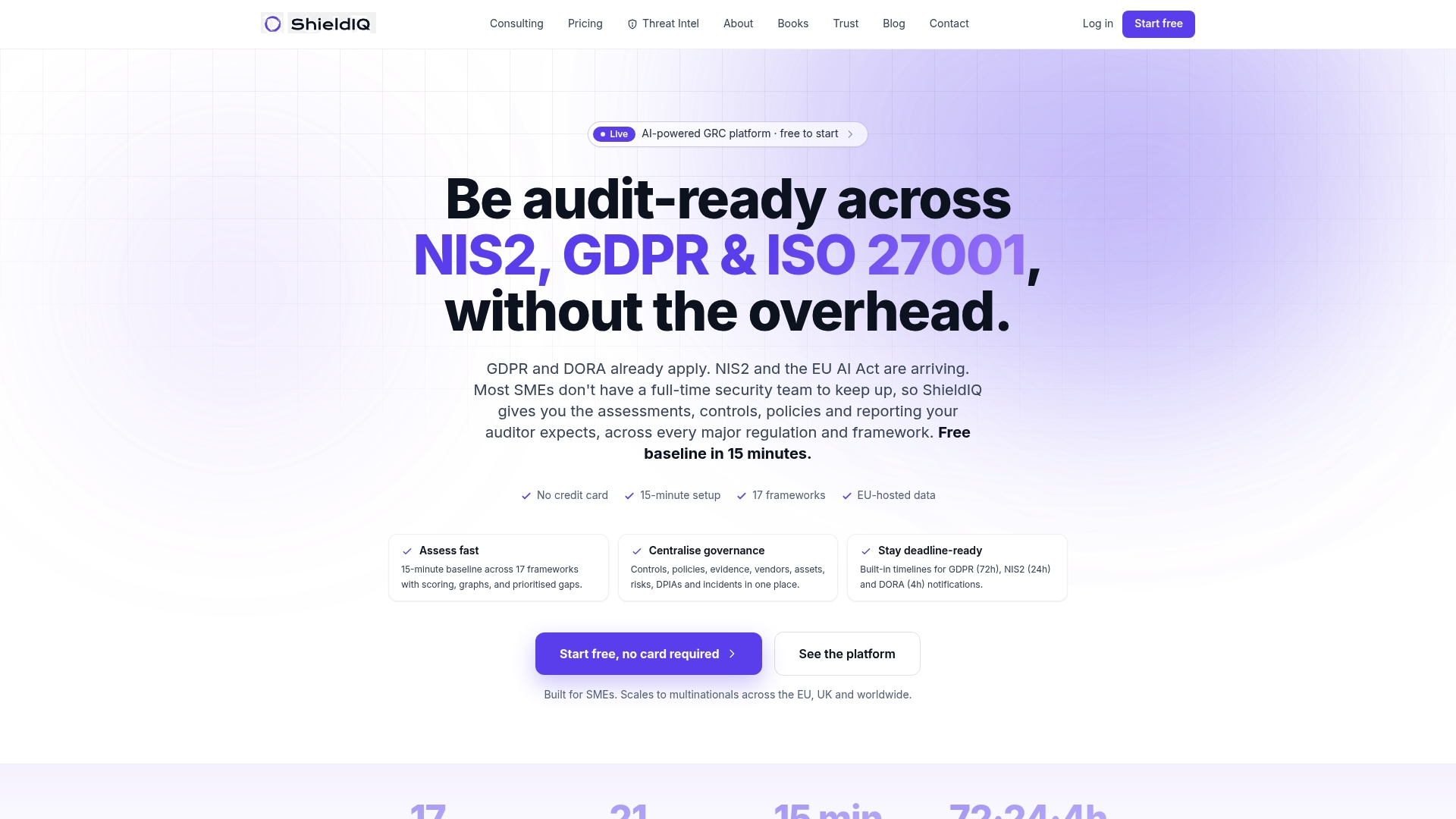
The platform's AI-driven policy drafting and automated assessments generate scored, gap-analysed evidence across NIS2, GDPR, ISO 27001, SOC 2, DORA, and the EU AI Act from one centralised dashboard, so a control you've already documented for one framework maps automatically to its equivalent elsewhere rather than being redrafted from scratch. That cross-framework mapping is exactly what a canonical answer library needs to stay accurate as your certifications grow.
Before you commit to any GRC platform, check it against a short list: does it maintain a genuine answer library, link evidence directly to specific controls, export an audit-ready package without manual reformatting, and cover more than one framework at once? If a tool falls short on any of those, you'll be back to manual work within a year.
If your questionnaire volume is growing faster than your team can answer it manually, book a look at ShieldIQ's platform or speak to the consulting team about getting your evidence base audit-ready before the next one lands.
Where to go for framework detail and templates
For deeper framework mapping, go directly to the source rather than a secondhand summary. The Shared Assessments SIG is the best starting point for mapping your answer library to standard vendor due-diligence domains. The Cloud Security Alliance's Cloud Controls Matrix and CAIQ are essential if you're answering as a cloud or SaaS provider. The Vendor Security Alliance format is useful when a buyer references it directly or when you want a lighter-weight internal baseline.
For technical control evidence, the CIS Controls give a practical checklist for operational security questions, and the NIST SP 800 series and ISO/IEC 27001 clause structure remain the reference points most enterprise custom questionnaires quietly borrow from. Community discussion and practical process write-ups, such as those from ISET+, are worth a periodic read for how other teams are handling rising questionnaire volume.
Frequently asked questions
What's the fastest way to answer a security questionnaire I've never seen before?
Start by identifying which framework it resembles (SIG, CAIQ, or a custom enterprise form), then check your answer library for existing answers to similar questions before drafting anything new.
Is it ever acceptable to answer "Yes" without direct evidence?
No. If you can't point to a specific document, report, or configuration that proves the claim, the honest answer is "Partial" or "No" with a remediation plan, not an unsubstantiated "Yes" that risks contractual liability later.
How long should a completed answer library take to build?
Do I need ISO 27001 or SOC 2 certification before I can answer questionnaires confidently?
No, but certification substantially reduces the volume of detailed questions you'll face, since many buyers accept a current ISO 27001 or SOC 2 report in place of a full manual questionnaire. Without certification, you'll need stronger individual evidence for each control claim.
What should I do if a questionnaire asks for something outside our contractual scope?
Flag it to your questionnaire owner and involve legal before answering. Document the scope mismatch in writing and propose a narrower response that matches what's actually contracted, rather than answering a question that expands your liability unnecessarily.
Sources
- Vendor Security Alliance
- CIS Controls download | CIS
- Vendor security questionnaire response guide (2026) | Decryption Digest