Risk Register Setup for SMEs: Audit-Ready in a Week
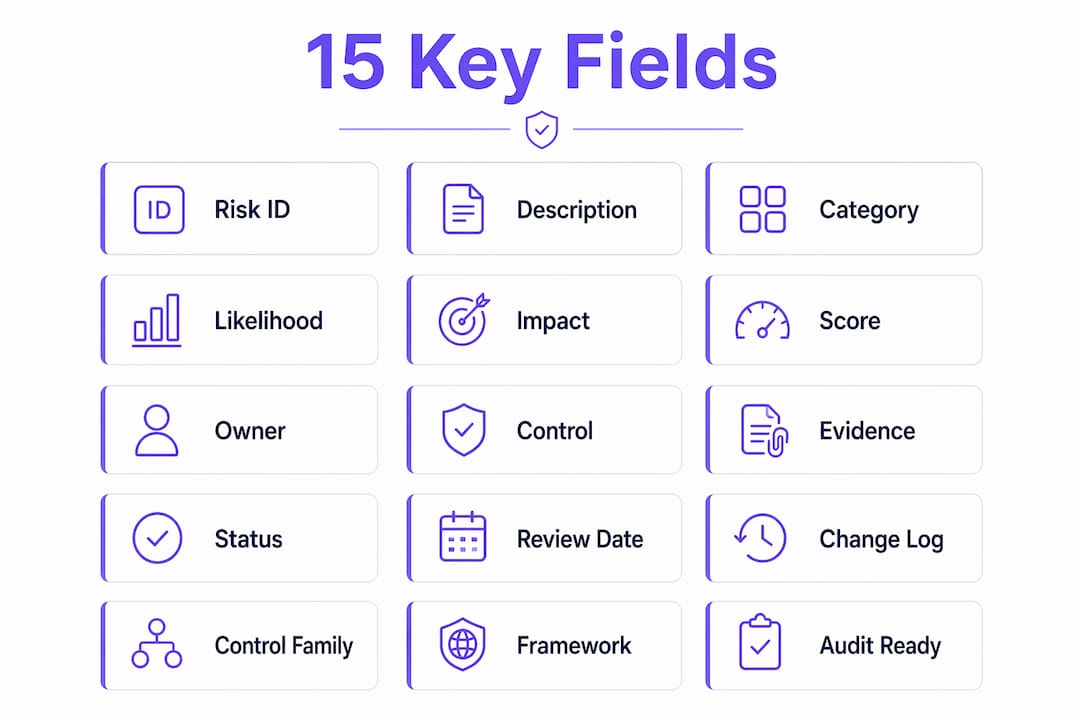
You can stand up a minimum viable, audit-ready risk register in one week. The formula is straightforward: a 15-field template, a named owner on every row, and a review cadence you actually follow. Frameworks like ISO 31000, COSO ERM, and the NIST RMF all converge on the same core process. Shieldiqcyber's GRC platform can automate the heavy lifting once the structure is in place.
The six essential actions, in order:
- Scope assets — identify systems, data, vendors, and processes in scope
- Identify risks — run a structured workshop using prompts and prior incident data
- Score inherent risk — rate likelihood and impact before any controls apply
- List controls — document what you already have in place and rate its effectiveness
- Calculate residual risk — re-score after controls; this is the number that drives decisions
- Assign owner and actions — one named person, a SMART action, a deadline, and a status
Quick-template callout: paste this into a spreadsheet row to start today:
R-001 | Remote access misconfiguration | Technology | Likely | Major | 4×4=16 | MFA + VPN policy | Partially Effective | Possible | Major | 3×4=12 | Jane Smith | Login anomaly rate | Patch MFA gaps by July 31 | In Progress | 2026-06-01
Table of Contents
- What fields does a working risk register actually need?
- How to build the register step by step
- Qualitative vs. quantitative scoring: which one fits your SME?
- The 15-field template and a paste-ready CSV row
- Governance: who owns what and when does it get reviewed?
- How to make your register audit-ready
- Which parts of the register can you automate?
- Key Takeaways
- Why most SME risk registers fail before they start
- Shieldiqcyber gets your register audit-ready faster
- Useful sources
What fields does a working risk register actually need?
Before you run a workshop, confirm you have these minimum steps covered:
- Define scope: which assets, processes, and third parties are in
- Agree on a risk taxonomy (Technology, People, Compliance, Operational, Financial)
- Schedule one 90-minute identification workshop with department leads
- Populate your top 20 risks with inherent scores
- Assign a named owner to every row
- Book recurring reviews into the calendar
Audit-ready risk registers require at least 15 fields. Lightweight five-column templates will not hold up under auditor scrutiny.
| Field | Example Value |
|---|---|
| Risk ID | R-001 |
| Description | Remote access misconfiguration exposes internal systems |
| Category | Technology |
| Inherent Likelihood | Likely (4) |
| Inherent Impact | Major (4) |
| Inherent Score | 16 |
| Existing Controls | MFA enforced, VPN policy documented |
| Control Effectiveness | Partially Effective |
| Residual Likelihood | Possible (3) |
| Residual Impact | Major (4) |
| Residual Score | 12 |
| Risk Owner | Jane Smith, IT Manager |
| KRI | Login anomaly rate >5/week |
| Action Plan & Status | Patch MFA gaps by July 31 — In Progress |
| Last Review / Evidence | 2026-06-01 / VPN config screenshot |
How to build the register step by step
Days 1–7: lay the foundation
Pick your tool first — a shared Google Sheet, Excel, or a GRC platform. Define your scoring rubric before anyone scores a single risk. Without agreed definitions, two assessors will rate the same event differently every time. Set your taxonomy, confirm the scope of assets and processes, and document the rubric in a tab everyone can see.

Pro Tip: Run a 15-minute calibration exercise on Day 1. Give three assessors the same hypothetical risk and compare scores. Resolve disagreements before the workshop, not after.
Days 8–21: populate and assign
Run your identification workshop. Bring department leads, your IT or security contact, and any compliance documentation you have. Use prompts: "What would stop us from operating for a week?" and "What did our last audit flag?" Aim for 20–40 candidate risks. Score each one for inherent likelihood and impact, log existing controls, rate control effectiveness, then calculate residual scores. Assign a named individual — not a department — to every row. Vendor risk deserves its own category; supplier failures are a common blind spot for SMEs.
Days 22–90: embed and monitor
Set KRI thresholds, build a simple dashboard, and schedule the first board or leadership report. Risks scoring 6 or above on a 5×5 scheme need active mitigation and monthly check-ins. Below that threshold, quarterly or semi-annual reviews are defensible. After an incident or a regulatory change, trigger an ad-hoc review regardless of the scheduled cadence.
Common traps to avoid: owners listed as "IT Team" instead of a person, scores that drift because no rubric was written down, and registers that grow to 200 rows and never get pruned.
Qualitative vs. quantitative scoring: which one fits your SME?
Start qualitative. A 5-point likelihood and impact scale with explicit probability bands gives you breadth across all risks quickly. Once you have inherent scores, apply quantitative analysis to your top 5–10 highest-rated risks.
| Score | Likelihood Label | Probability Band | Impact Label | Dollar Impact Example |
|---|---|---|---|---|
| 1 | Rare | <5% | Negligible | <$10K |
| 2 | Unlikely | 5–20% | Minor | $10,000 |
| 3 | Possible | 21–80% | Moderate | $50,000 |
| 4 | Likely | 51–80% | Major | $325,000 |
| 5 | Almost Certain | >80% | Catastrophic | >$1M |
Sample calculation: Remote access misconfiguration scores Likely (51–80% probability) with a Major impact ($500K estimated loss). Expected Annual Loss = 0.65 × $500,000 = $325,000. That figure justifies a $40,000 MFA upgrade immediately.
Practitioner guidance recommends starting qualitatively for breadth, then adding quantitative techniques for the highest-priority risks. Monte Carlo simulation is warranted only when a single risk could threaten solvency or when a regulator requires probabilistic modeling.
The 15-field template and a paste-ready CSV row
Every field below earns its place. Drop any one of them and you will have a gap an auditor will find.
- Risk ID: unique reference for traceability
- Description: one sentence, cause-and-effect format ("X occurs, causing Y")
- Category: from your agreed taxonomy
- Inherent Likelihood / Impact / Score: pre-control baseline
- Existing Controls: specific, named controls — not "we have security"
- Control Effectiveness: Effective, Partially Effective, or Ineffective
- Residual Likelihood / Impact / Score: post-control reality
- Risk Owner: first name, last name, job title
- KRI: the metric that signals the risk is moving
- Action Plan & Status: SMART action, owner, deadline, current status
- Last Review Date / Audit Evidence Link: timestamp plus a link to the evidence file
Paste-ready CSV row:
R-001,Remote access misconfiguration exposes internal systems,Technology,4,4,16,MFA + VPN policy,Partially Effective,3,4,12,Jane Smith,Login anomaly rate >5/week,Patch MFA gaps by 2026-07-31 - In Progress,2026-06-01
Add a "Version / Changed By / Change Date" column for your audit trail. Every edit to a row should log who changed what and when. A practical SME guide covers versioning in more detail.
Governance: who owns what and when does it get reviewed?
Assign a named individual to every risk and every significant control. A department name is not an owner. When accountability is diffuse, monitoring stalls and remediation never happens.
Recommended review cadence: high-priority risks monthly, medium priority quarterly, and low priority semi-annually. Surface high-risk items at board or risk committee level; medium risks at leadership meetings. After any incident or material regulatory change, review affected rows immediately regardless of schedule.
KPIs worth tracking: percentage of risks with a named owner (target: 100%), percentage of actions past their due date (target: <10%), and number of KRI threshold breaches in the last 30 days. The NIST RMF's continuous monitoring strategy reinforces this: organizational accountability for controls is not a one-time exercise.
How to make your register audit-ready
Map each register row to a control family and attach a piece of evidence. That single-row audit trace is what separates a working register from a document that exists only on paper. Auditors expect controls rated Effective, Partially Effective, or Ineffective — with evidence to back the rating.
| Risk | Control Family | Framework Mapping | Evidence Link | Audit Status |
|---|---|---|---|---|
| Remote access misconfiguration | Access Control | ISO 27001 / NIST AC-2 | VPN config log (SharePoint) | Reviewed |
| Unpatched third-party software | Vulnerability Mgmt | NIST SI-2 / SOC 2 CC | Patch scan report (June 2026) | In Progress |
| GDPR data subject request breach | Privacy | GDPR Art. 12 | DSR log + response template | Reviewed |
For ISO 27001 alignment, every Annex A control referenced in your Statement of Applicability should map to at least one register row. Auditors will cross-reference both documents.
Which parts of the register can you automate?
Automate evidence collection, KRI monitoring, and owner notifications. Use AI for candidate risk identification and scoring suggestions. Keep human validation for final scores and remediation decisions.
Practical automation workflows for an SME:
- Asset sync: pull from your CMDB or cloud inventory to keep the asset list current
- Vendor risk feed: auto-flag supplier changes that affect your third-party risk rows
- Scheduled KRI checks: trigger alerts when a metric crosses its threshold
- Owner notifications: auto-remind owners of overdue actions weekly
AI can classify new evidence, suggest risk categories for newly discovered assets, and flag scoring inconsistencies across assessors. Shieldiqcyber's platform handles automated assessments and evidence collection to reduce the time between a control change and an updated register row.
Pro Tip: Every AI-suggested score change must log the original value, the suggested value, the model version, and the human who approved it. That immutable trail is what regulators will ask for.
Guardrails matter. Opaque AI scoring with no audit trail creates a compliance liability, not an asset. For readers operating under AI regulation, the EU AI Act adds specific transparency requirements to automated decision-making in risk workflows.
Key Takeaways
A minimum viable, audit-ready risk register requires 15 fields, a named owner on every row, and a review cadence tied to risk priority — all achievable in one week.
| Point | Details |
|---|---|
| One-week setup is achievable | Scope, workshop, score, assign owners, and schedule reviews within seven days. |
| 15 fields are the minimum | Fewer fields leave gaps auditors will find; include control effectiveness and evidence links. |
| Named owners, not departments | Accountability stalls when a team is listed; assign a first and last name to every risk. |
| Review cadence by priority | High risks monthly, medium risks quarterly, low risks semi-annually; trigger ad-hoc after incidents. |
| Shieldiqcyber accelerates the process | Automated assessments, evidence collection, and KRI dashboards cut time to audit-ready. |
Why most SME risk registers fail before they start
The registers that fail share one trait: they were built to satisfy an audit, not to be used. A 200-row spreadsheet with no owners, no evidence links, and scores that were assigned in a single afternoon by one person is not a risk register. It is a liability document.
The fix is not a better template. It is governance. Named owners create pressure. Evidence links create accountability. A review cadence creates momentum. When those three elements are in place, the register becomes a living tool that actually changes decisions — which is the whole point.
SMEs often underestimate how much a maintained register accelerates an audit. When an auditor asks for evidence of a control, a linked file in the register row answers the question in seconds. Without it, the team spends days reconstructing what happened. That difference in audit preparation time is where the real ROI of a well-run register shows up.
Shieldiqcyber gets your register audit-ready faster
Spending a week building a register manually is the right starting point. Keeping it current over time is where most SMEs fall behind. Shieldiqcyber's GRC platform gives compliance leads pre-built 15-field templates, automated control evidence collection, KRI dashboards, and audit-ready reports across ISO 27001, GDPR, NIS2, SOC 2, and DORA — without needing a full-time security team to run it.
The platform's AI flags scoring inconsistencies, suggests risk categories for newly scanned assets, and notifies owners of overdue actions automatically. Every change logs a timestamped audit trail. If you want hands-on help standing up the register or preparing for a certification audit, Shieldiqcyber's consulting team can run the process with you from scoping through the first board report. Book a call and have a working register by end of week.
Useful sources
| Source | Best For |
|---|---|
| NIST RMF (CSRC) | Process alignment, continuous monitoring, control selection |
| NIST RMF | Detailed RMF steps, organizational accountability, evidence requirements |
| RiskPublishing: Risk Register Template Guide | 15-field template, scoring rubric, field-level best practices |
| RiskPublishing: Risk Assessment Process Guide | Qualitative vs. quantitative methods, review cadence |
| ReWork: Risk Register Template | Project risk register format, prioritization thresholds |
| NSW Government Risk Management Toolkit | Control effectiveness ratings, audit evidence expectations |
| COSO ERM | Enterprise risk governance, strategy integration, reporting |