Risk appetite statement: a practical guide for EU leaders
A risk appetite statement is a board-approved document that defines the types and aggregate level of risk an organisation is willing to accept in pursuit of its strategic objectives. Every effective one contains five components: a risk philosophy statement, categorised appetites by risk type, quantitative limits and qualitative boundaries, governance and ownership rules, and a monitoring and reporting framework.
Here is a minimal template outline your board can review in a single sitting:
- Risk philosophy: one or two sentences stating the organisation's overall stance on risk-taking relative to its strategy.
- Risk categories and appetite: a short statement per principal risk category (strategic, financial, operational, compliance, reputational, cyber) with an appetite level (e.g. low, moderate, high).
- Quantitative limits: measurable thresholds (earnings-at-risk, maximum downtime, liquidity floor) that define the outer boundary of acceptable exposure.
- Governance: named owners at board and executive level, approval authority, and escalation routes.
- Monitoring: key risk indicators (KRIs), reporting frequency, and the trigger points that prompt a review.
That structure is the minimum. What goes inside each component depends on your organisation's size, sector, and regulatory context, all of which the sections below address in detail.
Table of Contents
- What is the difference between risk appetite, risk tolerance, risk capacity, and risk profile?
- What must every risk appetite statement include?
- How do you write a risk appetite statement from scratch?
- Who owns the risk appetite statement, and how should governance work?
- How do you measure and monitor whether you are inside appetite?
- How can SMEs build a practical risk appetite statement without overcomplicating it?
- Sample risk appetite statements and quantitative limit examples
- Key takeaways
- Why most risk appetite statements fail in practice
- ShieldIQ helps you move from statement to working governance
- Useful sources and regulator guidance for further reading
What is the difference between risk appetite, risk tolerance, risk capacity, and risk profile?
These four terms appear in almost every governance document, yet they are routinely conflated. Getting them right is not pedantry; it directly affects how you resource controls and measure performance.
Risk appetite is the amount and type of risk an organisation is prepared to accept in pursuit of its objectives. It is forward-looking and strategic, set by the board, and expressed in the risk appetite statement. Risk tolerance is the acceptable variation around that appetite: the operational boundary within which management can act before escalation is required. If appetite is the policy, tolerance is the permitted deviation from it.
Risk capacity is the maximum risk the organisation can absorb before its viability is threatened, taking into account capital, liquidity, people, and regulatory constraints. Appetite should always sit inside capacity. Risk profile is a snapshot of the actual risk exposures the organisation carries at a given moment, measured against appetite and capacity.
| Term | Definition | Who sets it | Practical use |
|---|---|---|---|
| Risk appetite | Type and level of risk the organisation will accept to achieve objectives | Board | Guides strategy and resource allocation |
| Risk tolerance | Acceptable variation around appetite; operational boundary | Senior management | Sets limits and triggers for escalation |
| Risk capacity | Maximum risk absorbable before viability is threatened | Board/CFO | Caps appetite; informs capital planning |
| Risk profile | Current aggregate exposure at a point in time | CRO/Risk function | Measured against appetite and capacity |
Conflating appetite and tolerance is the most common governance error. When a board sets a "low appetite for operational disruption" but management never translates that into a specific tolerance (say, no more than four hours of system downtime per quarter), the appetite statement has no operational teeth. Controls get under-resourced, breaches go undetected, and the board only finds out after a significant incident.
The ERM Initiative at NC State University recommends tailoring the level of granularity to organisational maturity. A newly formed SME should start with clear category-level appetites and a handful of measurable tolerances rather than attempting to define thresholds for every conceivable risk.
Three authoritative frameworks underpin most EU governance practice. The Financial Stability Board's Principles for an Effective Risk Appetite Framework sets the international standard, particularly for financial institutions. COSO's Enterprise Risk Management framework links appetite directly to strategy and performance. The Institute of Risk Management (IRM) provides practitioner-level guidance suited to a broader range of sectors and organisation sizes.
What must every risk appetite statement include?
A risk appetite statement that cannot be acted upon is a compliance artefact. The components below are the difference between a document that sits in a board pack and one that actually guides decisions.
Risk philosophy and strategic link
Open with one or two sentences that state the organisation's overall stance. This should connect directly to the strategic plan. For example: "[Organisation] pursues growth in EU digital markets and accepts moderate strategic and technology risk in doing so, while maintaining a low appetite for regulatory non-compliance and reputational harm." The COSO ERM framework is explicit that appetite must be objective-focused and used proactively in decision-making, not only as a monitoring tool.
Risk categories and appetite levels
Define appetite for each principal risk category. The table below shows a standard categorisation with illustrative appetite levels:
| Risk category | Appetite level | Rationale |
|---|---|---|
| Strategic / growth | Moderate to high | Supports market expansion objectives |
| Financial / credit | Low to moderate | Protects balance sheet and liquidity |
| Operational | Low | Protects service continuity and efficiency |
| Regulatory / compliance | Minimal | Avoids fines, licence risk, and reputational damage |
| Reputational | Minimal | Brand and stakeholder trust are core assets |
| Cyber / information security | Low | Protects data, systems, and customer trust |
Quantitative limits and qualitative boundaries
Quantitative limits translate appetite into measurable thresholds: maximum earnings-at-risk, a liquidity floor, a maximum system-downtime tolerance, or a cap on unhedged foreign-exchange exposure. Qualitative boundaries cover risks that resist easy measurement, such as reputational risk or ethical conduct, and are expressed as principles or prohibited activities.
Assumptions and scenarios
State the key assumptions underpinning the appetite (e.g. stable macroeconomic conditions, no material regulatory change) and note the scenarios under which the board would expect to revisit them.
Allocation and cascading rules
The FSB is clear that appetite must cascade from the firm level to business lines and legal entities. Each business unit should receive an allocated sub-appetite and corresponding limits, so that the aggregate of all unit-level exposures does not exceed the firm-wide appetite. Without this, the board-level statement is disconnected from day-to-day operations.
How do you write a risk appetite statement from scratch?
The process has four stages: gathering inputs, drafting, consulting and approving, and cascading. Each stage has a defined owner and output.
-
Gather inputs. Collect the current strategic plan, the principal risk register, capital and liquidity analysis, regulatory requirements (NIS2, GDPR, DORA where applicable), and stakeholder expectations. A cybersecurity risk assessment is a practical starting point for identifying principal risks in the technology and information security categories.
-
Consult and approve. Circulate the draft to the CEO, CFO, CRO, and relevant committee chairs. The board formally approves the statement, and that approval is recorded in board minutes. The Institute of Internal Auditors identifies board approval and documented evidence of oversight as critical governance trust signals.
The table below maps each stage to its primary owner and output:
| Stage | Primary owner | Output |
|---|---|---|
| Inputs | CRO / Risk lead | Principal risk list, capacity analysis |
| Draft | CRO / Risk lead | Draft RAS document |
| Consult | CEO, CFO, committee chairs | Revised draft with comments |
| Board approval | Board | Approved RAS, recorded in minutes |
| Cascade | Business-line owners | Unit-level sub-appetites and limits |
| Embed | CEO / COO | Decision-gate procedures updated |
Timing matters. Align the annual RAS review with the strategic planning cycle so appetite and strategy are updated together. Ad-hoc reviews should be triggered by material regulatory changes (such as a new DORA obligation or a NIS2 scope extension), significant macroeconomic shifts, or a major risk event. A statement left unchanged for more than 12–24 months almost certainly no longer reflects the organisation's actual risk environment.
Who owns the risk appetite statement, and how should governance work?
Ownership is not a formality. Unclear accountability is one of the most reliable predictors of a risk appetite statement that collects dust rather than guides decisions.
Board responsibilities
The board sets the context for appetite, formally approves the statement, and reviews outcomes against it at least annually. Board members do not draft the detail, but they must challenge the assumptions, satisfy themselves that appetite is consistent with strategy and capacity, and ensure the evidence of that engagement is captured in minutes and committee papers. The IIA's guidance is explicit: board approval and documented oversight are non-negotiable governance requirements.
CEO, CRO, and CFO roles
The CEO is accountable for ensuring the organisation operates within appetite and that the culture supports it. The CRO (or equivalent risk lead in smaller organisations) drafts the statement, selects KRIs, and reports performance against appetite to the board. The CFO provides the capital and liquidity analysis that defines risk capacity and translates financial appetite into treasury and credit limits.
Committees and reporting lines
A risk committee (or audit and risk committee in smaller organisations) reviews the RAS before board approval and monitors performance throughout the year. Business-line owners report against their allocated sub-appetites to the risk committee, which escalates breaches or emerging concerns to the board. Internal audit provides independent assurance that the framework is operating as designed.
Pro Tip: Record not just the approval of the RAS in board minutes, but the specific questions the board asked and the assumptions they challenged. Regulators and auditors look for evidence of active engagement, not a rubber stamp.
Escalation routes
Define clear escalation thresholds: what triggers a report to the risk committee, what triggers an emergency board discussion, and what triggers an immediate operational response. Without these, a limit breach can sit unresolved for weeks.
How do you measure and monitor whether you are inside appetite?
A risk appetite statement without measurement is a statement of intent, not a governance tool. The measurement layer is what converts board-level policy into operational reality.
Selecting KRIs
Key risk indicators are the metrics that tell you whether you are approaching, at, or beyond a risk limit. Select two or three per principal risk category. Good KRIs are leading (they warn before a breach, not after), measurable with available data, and directly linked to a specific appetite statement.
| Risk category | Example KRI | Limit example | Escalation trigger |
|---|---|---|---|
| Financial | Net interest margin variance | — | >10% variance for two consecutive months |
| Operational | System availability | ≥99.5% monthly uptime | Any month below 99.5% |
| Cyber | Critical vulnerabilities unpatched | Zero critical CVEs >30 days old | Any critical CVE unpatched at day 21 |
| Compliance | Overdue regulatory actions | Zero overdue items | Any item overdue by >7 days |
| Reputational | Customer complaint escalation rate | <2% of interactions | Rate exceeds 2% in any rolling quarter |
For organisations building out their cyber KRIs, cloud risk management approaches offer practical methods for measuring IT and infrastructure exposures that map directly to appetite limits.
Stress testing and scenario analysis
Stress testing asks: what would push us outside appetite or beyond capacity? Run at least two scenarios annually: one based on a plausible adverse macro event (a significant economic downturn, a major regulatory enforcement action) and one based on a severe but plausible operational event (a prolonged cyber incident, a key supplier failure). Both COSO and the FSB identify forward-looking stress testing as a core component of a sound risk appetite framework. The output should tell the board whether current appetite and capacity remain appropriate under stress, or whether limits need tightening.
Dashboard design
Executive dashboards should show, at a glance: current status of each KRI (green/amber/red against limit), trend over the past quarter, any active limit breaches, and the status of remediation actions. Board-level reports need a higher-level summary: aggregate risk profile versus appetite, any material changes since the last review, and the results of the most recent stress test. Keep board reports to two or three pages; detail belongs in the committee papers.
- Confirm each KRI has a named owner and a data source.
- Set reporting frequency per category (monthly for operational and cyber; quarterly for strategic and reputational).
- Define amber and red thresholds separately from the hard limit.
- Include a trend indicator, not just a point-in-time status.
- Attach a standard escalation note to any amber or red item before it reaches the board.
How can SMEs build a practical risk appetite statement without overcomplicating it?
Most SME boards do not need a 40-page risk appetite framework. They need a one-page statement they can actually use. The practitioner's guide published by the UK government offers a pragmatic template approach that translates well to EU SME contexts.
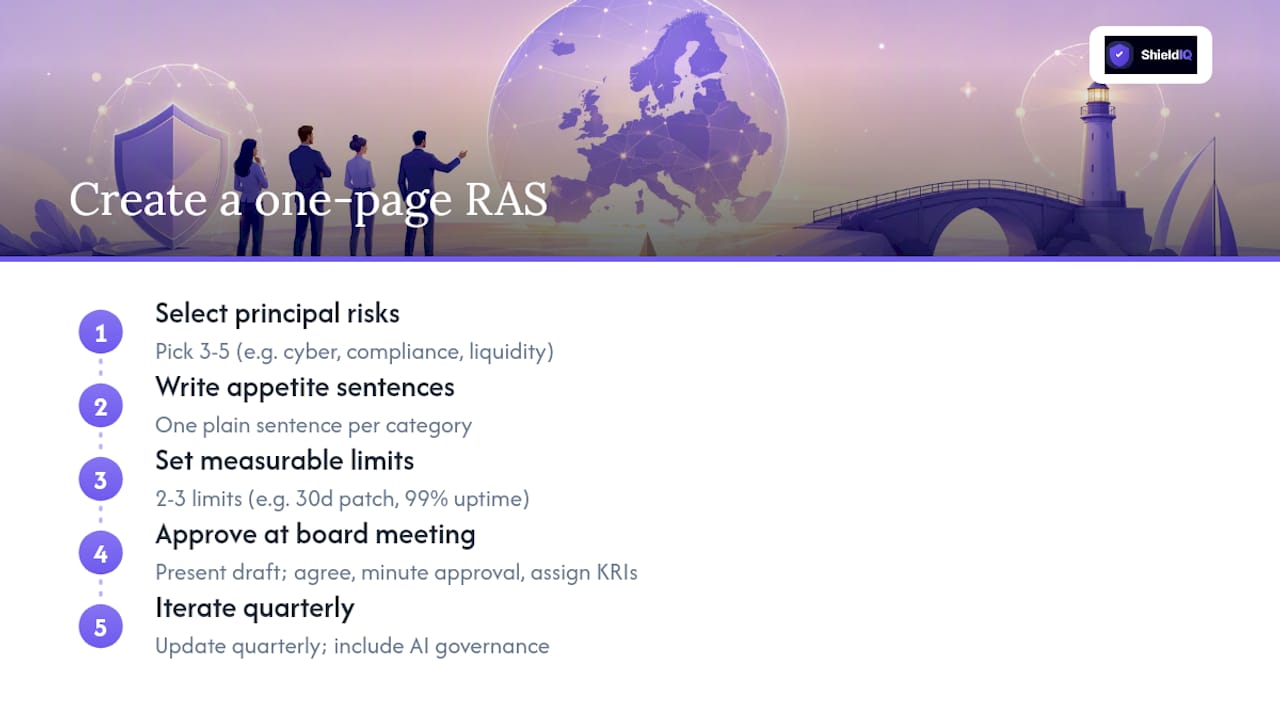
Start with three to five principal risks. Identify the risks that, if they materialised, would most threaten your strategic objectives or operational continuity. For most SMEs, these will include cyber and data security, regulatory compliance (GDPR, NIS2), financial liquidity, key-person dependency, and supply-chain disruption.
Write one appetite sentence per category. Keep it plain. "We have a low appetite for data breaches and will invest in preventive controls proportionate to the sensitivity of the data we hold" is more useful than a paragraph of caveats.
Set two or three measurable limits. For cyber, this might be: no critical vulnerabilities unpatched beyond 30 days, and 99% system availability. For compliance: zero overdue regulatory filings. These limits give management something to monitor and give the board something to ask about.
Pro Tip: Run your first RAS through a single board meeting. Present the draft, agree the category appetites and limits, record the approval in minutes, and assign KRI ownership. You can refine the document over subsequent quarters as your data matures.
For organisations using AI systems, AI governance maturity models provide a useful lens for calibrating appetite in that specific risk category, particularly as the EU AI Act creates new compliance obligations.
Shortcuts for immature data environments
When you do not yet have reliable historical data for a KRI, use a proxy. If you cannot measure mean-time-to-detect a security incident directly, track the number of staff who have completed security awareness training as a leading indicator of human risk. As your data matures, replace the proxy with the direct measure.
Scaling the RAS as maturity grows
Year one: one-page statement, three to five risks, a handful of limits. Year two: add a second tier of risks, introduce stress testing for the top two categories. Year three: formalise the cascade to business units and introduce a risk dashboard. The risk register setup guide from ShieldIQ covers the practical steps for maintaining a register that feeds directly into your appetite monitoring.
Sample risk appetite statements and quantitative limit examples
The three excerpts below are starting points, not finished documents. Adapt the wording and numbers to your organisation's strategy, sector, and regulatory context.
-
Strategic growth appetite (moderate to high): "[Organisation] accepts moderate to high strategic risk in pursuit of its growth objectives in EU digital markets. We will enter new markets and launch new products where the expected return justifies the risk, provided that regulatory compliance and reputational standards are maintained. We will not pursue growth that requires accepting more than [X]% earnings-at-risk in any single financial year."
-
Conservative financial appetite (low): "[Organisation] maintains a low appetite for financial risk. We will hold a minimum liquidity reserve equivalent to [X] months of operating costs at all times. We will not enter into unhedged foreign-currency exposures exceeding [€X] in aggregate. Any transaction that would reduce our liquidity reserve below the floor requires board approval."
-
Balanced cyber posture (low to moderate): "[Organisation] accepts a low appetite for cyber and information security risk. We will maintain controls aligned with [ISO 27001 / NIS2 / Cyber Essentials] and will not tolerate critical vulnerabilities remaining unpatched beyond 30 days. We accept a moderate appetite for adopting new technologies where security controls are assessed and approved in advance."
The NHSCFA's published risk appetite statement is a useful public-sector reference for how a board-approved statement frames appetite to support strategic objectives, including the specific language used to distinguish categories.
Numeric limit examples
| Risk category | Appetite level | Quantitative limit |
|---|---|---|
| Earnings-at-risk | Low to moderate | Maximum 10% of annual EBITDA |
| Liquidity | Low | Minimum 3 months' operating costs in liquid reserves |
| System downtime | Low | Maximum 4 hours unplanned downtime per quarter |
| Data breach | Minimal | Zero incidents involving personal data of >100 individuals |
| Regulatory filing | Minimal | Zero overdue filings at any point |
Key takeaways
A risk appetite statement is only as useful as the governance, measurement, and cascading that surrounds it: boards that approve a statement without KRIs, limits, and a cascade to business units are signing a document, not setting policy.
| Point | Details |
|---|---|
| Appetite vs tolerance | Appetite is the board's strategic boundary; tolerance is the operational variation management can accept before escalating. |
| Five essential components | Every RAS needs a philosophy, categorised appetites, quantitative limits, governance ownership, and a monitoring framework. |
| Cascade is non-negotiable | Firm-wide appetite must be allocated to business lines with specific, measurable sub-limits that operational teams can act on. |
| KRIs make it measurable | Without named KRIs and escalation thresholds, appetite cannot be monitored and the statement has no governance value. |
| ShieldIQ for SMEs | ShieldIQ's GRC platform automates KRI tracking, policy creation, and audit-ready reporting, helping EU SMEs embed and monitor their risk appetite without a dedicated risk team. |
Why most risk appetite statements fail in practice
The conventional wisdom says that a well-written RAS is the hard part. Get the language right, get the board to sign it, and the governance problem is solved. That framing is wrong, and it is why so many organisations have a polished document that nobody uses.
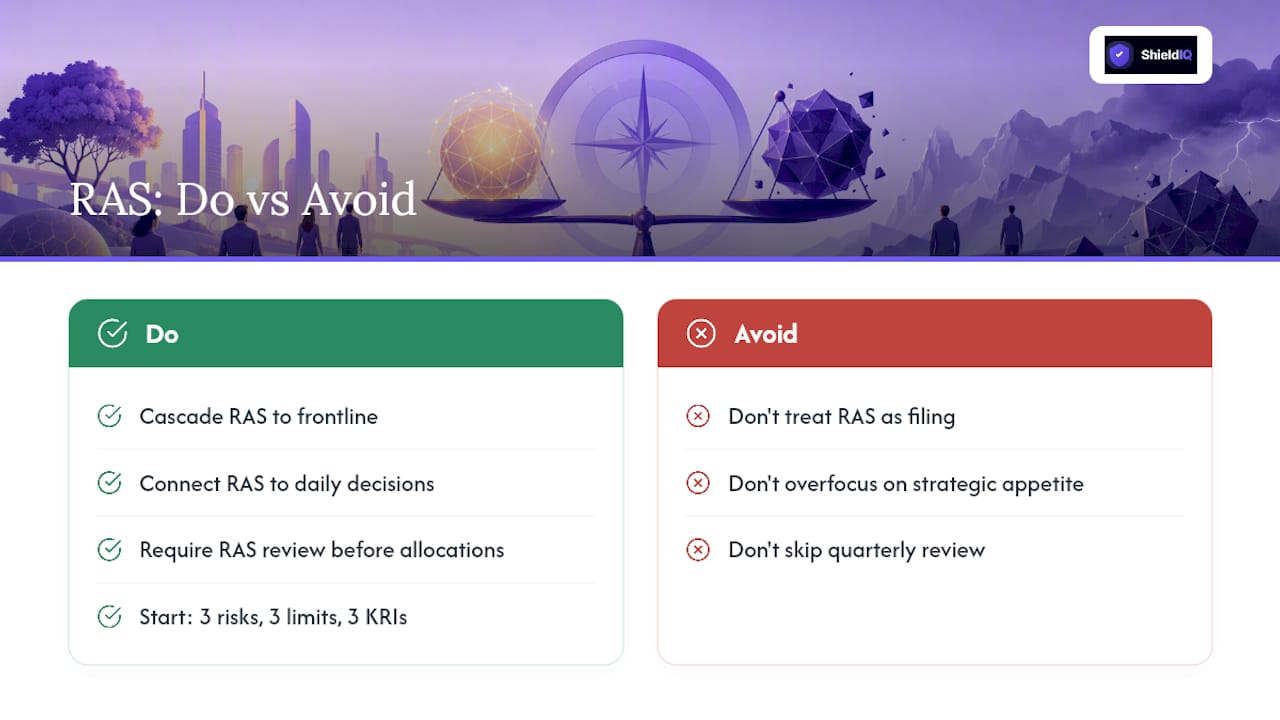
The real difficulty is not drafting. It is the three steps that come after: cascading the statement to people who have never read it, connecting it to decisions that happen daily, and maintaining it when the regulatory environment shifts. A board that approves a risk appetite statement in January and does not look at it again until the following January has not embedded governance. It has produced a filing.
What actually works is treating the RAS as a decision-making tool rather than a compliance output. Embedding a mandatory risk appetite review before capital allocation decisions forces the board and executive team to use the statement in real time. That single procedural change does more for governance quality than any amount of refinement to the document's language.
The other underappreciated issue is specificity at the wrong level. Many organisations spend significant effort defining appetite for strategic and reputational risks, which are genuinely hard to measure, while leaving cyber and operational risks with vague statements and no KRIs. Those are precisely the categories where measurable limits are most achievable and most valuable. A statement that says "we have a low appetite for cyber risk" but cannot tell the board whether the organisation is currently inside that appetite is not a governance tool.
For SMEs in particular, the temptation to build a comprehensive framework before the data exists to support it leads to documentation that cannot be maintained. Start with three risks, three limits, and three KRIs. Review them quarterly. Add complexity only when the simpler version is working.
ShieldIQ helps you move from statement to working governance
Getting a risk appetite statement drafted is one thing. Making it operational, with live KRI tracking, automated policy controls, and audit-ready evidence, is where most organisations stall.
ShieldIQ's GRC platform is built for EU SMEs that need to move from a board-approved statement to a working governance framework without hiring a full-time risk team. The platform's automated assessments map directly to your principal risk categories, its policy engine generates tailored controls aligned to frameworks including NIS2, GDPR, ISO 27001, and DORA, and its dashboards give your board the KRI visibility they need at every reporting cycle. For organisations that need hands-on support, ShieldIQ's consulting services include RAS workshops, KRI setup, and Virtual CISO engagements that take you from a blank page to a board-approved statement with a live monitoring framework. Book a consulting call or start a platform trial at shieldiqcyber.com.
Useful sources and regulator guidance for further reading
The sources below are listed in recommended reading order for boards and compliance leads building or reviewing a risk appetite framework.
- Principles for an Effective Risk Appetite Framework
- COSO: Enterprise risk management — integrating with strategy and performance
- A comprehensive guide to risk appetite and risk tolerance | ERM Initiative
- Managing your risk appetite: a practitioner's guide
- Risk Appetite statement | Corporate and information ... (NHSCFA)
- What is a Risk Appetite Statement? Examples & Best Practices | MetricStream
- The Institute of Internal Auditors (The IIA)
When citing these documents in board packs, reference the source name, publication date, and the specific principle or section you are relying on. For example: "Consistent with FSB Principle 3, the board has allocated firm-wide appetite to each principal business line, as documented in Annex B." That level of specificity signals active engagement rather than a generic reference.