SOC 2 cost for EU SMEs: budget guide 2026
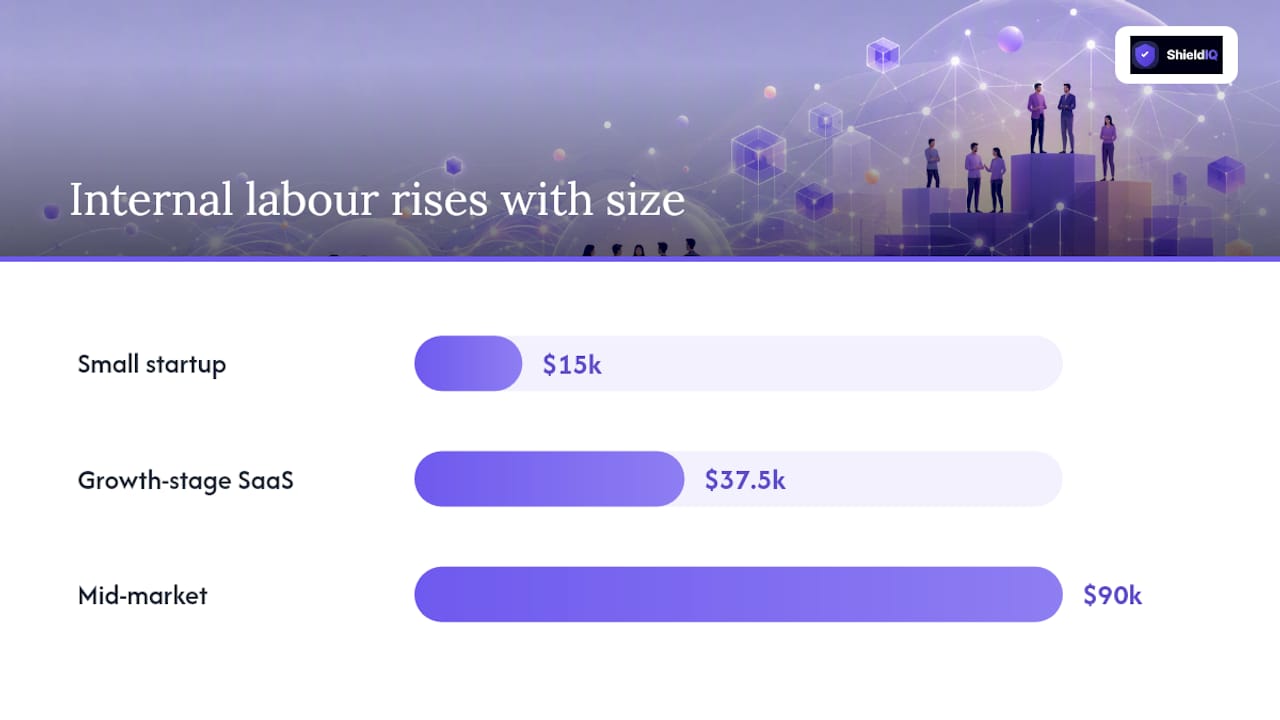
For most EU SMEs pursuing SOC 2 for the first time, the realistic first-year total sits between $30,000 and $150,000 when you include readiness, tooling, remediation, and internal labour alongside the auditor fee itself. The auditor fee alone typically represents a significant portion for a Type 2 engagement at a specialist or regional firm, but that figure is often less than half of what the full programme actually costs.
-
What to budget for your first conversation: A first-year total within a moderate range is a reasonable working figure for a small EU SaaS company targeting the Security criterion with a straightforward cloud stack. Expect the auditor fee to represent a meaningful portion of that total.
-
The fastest way to reduce surprises: Commission a scoping and readiness gap assessment before you approach auditors. It defines your control boundary, surfaces remediation work early, and gives auditors a cleaner picture, which directly lowers fieldwork hours and quote risk.
Assumptions throughout this guide: EU SME, Security Trust Services Criterion as the default scope, Type 2 as the typical target, single-location operation unless stated otherwise.
Table of Contents
-
What does “SOC 2 cost” actually include beyond the auditor fee?
-
Type I versus Type II: which audit does your EU business actually need?
-
What does readiness actually cost, and what does each task involve?
-
How EU businesses reduce SOC 2 costs without weakening controls
-
Who can perform a SOC 2 audit in the EU, and what should you ask for in quotes?
-
How SOC 2 costs differ for EU companies compared to US counterparts
What does “SOC 2 cost” actually include beyond the auditor fee?
The phrase “SOC 2 audit cost” is where most budgeting conversations go wrong. Buyers focus on the auditor’s quote and forget the five or six other cost buckets that make up the real programme expense. The table below shows the full picture for a typical EU SME in year one.
| Cost bucket | Typical EU SME first-year range | Recurrence |
|---|---|---|
| Readiness / gap assessment | a moderate cost range typical for SMEs | One-off (repeat if major changes) |
| Policy writing and documentation | a typical cost with annual review; lower after year one | |
| Remediation and tooling | moderate to substantial costs depending on scope | Partially recurring (licences) |
| Compliance platform / GRC tool | ongoing subscription fee typical for SME tiers | Annual subscription |
| Penetration testing | customary annual testing cost | Annual |
| Auditor fee (Type 2, Security) | typical annual audit fee range depending on firm and scope | Annual |
| Legal review of report | customary legal review cost per cycle | |
| Internal staff time (loaded cost) | significant internal labour cost typical for SMEs | Annual; lower after year one |
The auditor fee covers fieldwork, sampling, evidence review, and the final attestation report. It does not cover the work needed to get your controls to a state where they can be tested. That preparation work, which includes writing policies, configuring logging, tightening access controls, and fixing gaps, is entirely separate and falls on your team or your consultant. Treating the auditor quote as the total budget is one of the most common and costly planning errors EU SMEs make.
Type I versus Type II: which audit does your EU business actually need?
A Type I report attests that your controls are designed appropriately at a single point in time. A Type II report attests that those controls operated effectively over an observation period, typically six to twelve months. Most enterprise customers and US-headquartered buyers will ask for Type II, so it is the practical target for most EU SaaS companies.
Aggregated fee data from 171 firms shows Type I audit fees ranging from roughly $10,000 to $150,000 and Type II fees from $15,000 to $430,000, with the wide spread driven almost entirely by firm tier and scope complexity. For an EU SME at a specialist or regional firm, audit fee ranges tend to be more moderate.
| Type I | Type II | |
|---|---|---|
| What it tests | Design of controls at a point in time | Operation of controls over 6–12 months |
| Typical auditor fee (specialist/regional firm) | moderate range depending on audit type and complexity | |
| Observation period required | None | 6–12 months |
| Customer acceptance | Limited; often a stepping stone | Standard requirement for enterprise deals |
| When it makes sense | Pre-sales proof of concept; first-time programmes | Ongoing customer requirement; renewals |
Sequencing advice: Starting with a Type I report is reasonable if you need to demonstrate compliance quickly for a specific deal and your controls are not yet mature enough to sustain a twelve-month observation. The budget trade-off is real, though. You pay for two separate engagements rather than one, and the combined cost of a Type I followed by a Type II typically exceeds going straight to Type II. If your timeline allows six months of observation, go directly to Type II.
-
Type I suits companies under immediate commercial pressure who need something on paper within three to four months.
-
Type II suits companies with a six-to-twelve-month runway and enterprise customers who will not accept a point-in-time report.
-
Skipping Type I and investing that budget in readiness work instead often produces a better outcome at a lower total cost.
What does readiness actually cost, and what does each task involve?
Readiness is the work you do before the auditor arrives. For many EU SMEs, it is the largest single cost bucket in year one, and it is almost entirely within your control to manage.
Readiness task checklist with typical cost bands (EU SME, simple cloud stack):
-
Gap assessment: $3,000–$10,000 with a consultant; $1,500–$5,000 with a GRC platform. Identifies which controls you already have and which need building. This is the single most important investment before anything else.
-
Policy writing (information security, access control, incident response, change management, vendor management): $2,000–$8,000 with a consultant; significantly lower with AI-assisted policy generation tools.
-
Access control configuration (MFA, least privilege, access reviews): Primarily internal engineering time; tooling costs $500–$3,000 per year depending on your identity provider.
-
Logging and monitoring (SIEM or log aggregation): $2,000–$10,000 per year for tooling; setup effort is typically 20–60 internal hours.
-
Mobile device management (MDM): $1,000–$5,000 per year for a solution covering your endpoint fleet.
-
Change control process: Mostly process and documentation work; $500–$2,000 if a consultant formalises it.
-
HR and onboarding processes (background checks, security training, offboarding): $1,000–$4,000 per year for tooling and training delivery.
-
Vulnerability management and penetration testing: $5,000–$15,000 for an annual external pentest from a reputable EU firm.
Consultant versus automation platform:
-
A consultant-led readiness engagement gives you expert judgement and hands-on remediation support. Expect to pay $15,000–$40,000 for a full readiness programme with a specialist firm.
-
A GRC automation platform handles gap scanning, policy generation, evidence collection, and audit-ready reporting at a fraction of that cost, typically $5,000–$20,000 per year. The trade-off is that you need internal resource to act on the platform’s findings.
-
The most cost-effective approach for most EU SMEs is a platform for the repeatable work combined with targeted consultant hours for complex remediation or control design questions.
Concrete sample budgets for EU SMEs by size
These three profiles give finance owners a starting point for board-level budget conversations. All figures are in USD, as SOC 2 audit fees are almost universally quoted in dollars by international firms; apply a conversion at current rates for EUR or GBP planning purposes. A CPA-led cost matrix confirms these allocation patterns across company sizes.
| Profile | Auditor fee | Tooling & platform | Remediation | Internal labour (loaded) | First-year total |
|---|---|---|---|---|---|
| Small startup (10–30 staff, single SaaS product, Security criterion only) | $30,000–$150,000 | $5,000–$15,000 | $8,000–$20,000 | $10,000–$20,000 | $30,000–$150,000 |
| Growth-stage SaaS (30–100 staff, Security + Availability, multi-cloud) | $15,000–$60,000 | $10,000–$20,000 | $15,000–$60,000 | $15,000–$60,000 | $30,000–$150,000 |
| Mid-market (100+ staff, multiple criteria, subservice orgs in scope) | $40,000–$60,000 | $15,000–$60,000 | $15,000–$60,000 | $30,000–$150,000 | $30,000–$150,000 |
Assumption callouts:
-
All profiles assume a Type 2 engagement with a six-to-twelve-month observation window.
-
Internal labour is calculated at a blended loaded rate of $75–$100 per hour for engineering and security staff time.
-
Remediation figures assume a moderate gap count from a readiness assessment; a clean environment will sit at the lower end.
-
These ranges do not include legal fees for customer contract negotiations triggered by the report.
Biggest budget risks by profile:
-
Small startup: Underestimating internal hours. A lean team where the same person owns engineering, security, and compliance will burn more hours than the estimate above.
-
Growth-stage SaaS: Multi-cloud scope creep. Adding a second cloud provider mid-observation can force auditors to expand sampling, pushing fees above the upper bound.
-
Mid-market: Subservice organisation evidence. If third-party providers cannot supply their own SOC 2 reports, your auditor must test those controls directly, which adds significant fieldwork cost.
For EU-specific benchmarking techniques that help you adjust these US-origin figures to local market rates, practical benchmarking guidance is a useful reference when calibrating your planning numbers.
How EU businesses reduce SOC 2 costs without weakening controls
The three highest-impact tactics are: narrow your scope deliberately, automate evidence collection, and complete remediation before the observation window opens. Everything else is incremental.
-
Narrow scope to the production boundary. Define your system description tightly around the product or service your customers use. Exclude internal tools, development environments, and back-office systems unless they directly process customer data. A tighter boundary means fewer systems for auditors to sample and fewer controls to test.
-
Automate evidence collection. Manual evidence gathering, screenshots, spreadsheets, and email threads, is where internal hours disappear. SOC 2 automation platforms connect to your cloud providers, identity systems, and ticketing tools to pull evidence continuously, reducing the evidence-collection burden from weeks to hours. That reduction translates directly into lower auditor fieldwork costs because auditors receive organised, complete evidence packs rather than chasing your team for missing artefacts.
-
Complete remediation before the observation window. Controls that fail during fieldwork trigger exception documentation, possible re-testing, and extended engagement time. Fixing known gaps before the clock starts is always cheaper than fixing them under audit pressure.
Additional tactics worth applying:
-
Leverage existing controls from other frameworks. If you already have ISO 27001 or GDPR controls in place, many of them map directly to SOC 2 Trust Services Criteria. Cross-framework control mapping avoids rebuilding what you already have.
-
Use standardised vendor questionnaires. The Shared Assessments SIG provides a standardised format for gathering evidence from subservice organisations, which reduces duplicate requests and speeds vendor assessments.
-
Negotiate a fixed-price audit scope. Time-and-materials audit engagements expose you to cost overruns if fieldwork takes longer than expected. A fixed-price scope with clearly documented assumptions protects your budget.
-
Stage non-essential criteria. If a customer requires Availability but not Privacy, add Privacy in year two rather than year one. Each deferred criterion saves $5,000–$15,000 in year-one audit fees.
Pro Tip: To calculate the payback on a GRC automation platform, estimate the internal hours your team currently spends on evidence collection, policy maintenance, and audit preparation. Multiply by your loaded hourly rate. If that figure exceeds the platform’s annual licence cost, the platform pays for itself before you factor in the reduction in auditor fieldwork hours it typically produces.
How long does SOC 2 take for EU SMEs?
A realistic readiness window for a small EU SME with moderate gaps is three to six months. The Type 2 observation period then runs for a minimum of six months, with twelve months being the standard for enterprise customer requirements. Total time from starting readiness to receiving a Type 2 report: nine to eighteen months for most EU SMEs.
-
Gap assessment (weeks 1–4): Map your current controls against the Trust Services Criteria. Identify gaps and prioritise remediation by risk and audit impact.
-
Remediation (months 1–4): Fix the gaps identified. This is the phase where most of the readiness cost is incurred. Prioritise access control, logging, and change management first, as these generate the most auditor evidence requests.
-
Type I engagement (optional, months 3–5): If you need a point-in-time report for a specific deal, engage an auditor for a Type I. This does not replace the Type 2 observation period.
-
Type 2 observation window (months 4–16): Your controls must operate consistently throughout this period. Auditors will sample evidence from across the window, so gaps that appear mid-observation are visible.
-
Fieldwork and reporting (months 15–18 for a twelve-month window): Auditors conduct fieldwork, typically two to six weeks of active engagement, then draft and issue the report.
Timeline by company profile:
-
Small startup, simple stack: Readiness 2–4 months, observation 6 months, fieldwork 3–4 weeks. Total: 9–11 months.
-
Growth-stage SaaS, multi-cloud: Readiness 3–6 months, observation 6–12 months, fieldwork 4–6 weeks. Total: 12–18 months.
-
Mid-market, multiple criteria: Readiness 4–6 months, observation 12 months, fieldwork 6–8 weeks. Total: 16–20 months.
Scheduling tips: Start your readiness assessment at least six months before you need to show a customer a report. If a deal requires a Type 2 report within twelve months, begin immediately. Delays in remediation push the observation start date back, which pushes the report date back by the same amount.
Who can perform a SOC 2 audit in the EU, and what should you ask for in quotes?
SOC 2 is an American Institute of Certified Public Accountants (AICPA) attestation standard. Audits must be performed by a licensed CPA firm or, in EU jurisdictions, a recognised audit firm with demonstrated SOC 2 experience and AICPA-aligned methodology. There is no EU-specific accreditation body for SOC 2; what matters is the firm’s track record, methodology, and whether their reports are accepted by your customers.
When evaluating a firm, verify:
-
Active CPA licence or equivalent recognised audit qualification.
-
Documented SOC 2 engagements in the past two years, with references available.
-
Familiarity with EU data residency and GDPR considerations that may affect your system description.
-
Clear methodology for sampling, including how they handle cloud-native evidence.
Quote questionnaire: line items to demand from every auditor:
-
Estimated fieldwork hours broken down by phase (planning, evidence review, testing, reporting).
-
Sample sizes for key control categories (access reviews, change management, incident response).
-
Travel and on-site costs, if applicable.
-
Report deliverables: draft review process, management response period, final issuance timeline.
-
Re-testing rates: what happens if a control fails and must be retested?
-
Assumptions about your remediation state at observation start.
-
Scope assumptions: exactly which systems, services, and subservice organisations are included.
-
What triggers a scope change and how additional fees are calculated.
Red flags in audit proposals:
-
A single-line auditor fee with no assumptions or scope definition attached.
-
No explanation of sample sizes or sampling methodology.
-
Vague scope language such as “all IT systems” with no system boundary defined.
-
No mention of how subservice organisations are handled.
-
A quote that does not distinguish between Type I and Type II deliverables.
Common surprises that inflate SOC 2 costs after you sign
Hidden costs are not usually the result of bad faith. They arise from scope assumptions that were never written down, remediation work that was not completed before fieldwork started, and third-party dependencies that were not accounted for at the outset.
-
Scope creep during fieldwork. Auditors discover systems that process in-scope data but were not listed in the original scope. Each addition extends sampling and increases fees.
-
Subservice organisation evidence gaps. A cloud provider or payment processor that cannot supply their own SOC 2 report forces your auditor to test those controls directly. Budget $3,000–$10,000 per unresolved subservice organisation. Using the Shared Assessments SIG framework to standardise vendor evidence requests reduces this risk.
-
Failed control tests and re-testing. A single failed control test can add $2,000–$8,000 in re-testing and remediation costs, plus the reputational cost of exceptions in your final report.
-
Forgotten tooling licences. SIEM, MDM, vulnerability scanning, and training platforms all carry annual licence costs that are easy to omit from the initial budget.
-
Integration and configuration costs. Connecting your GRC platform to your cloud provider, identity system, and ticketing tool takes engineering time. Budget 10–30 hours of internal engineering effort for initial integrations.
-
Legal change requests on the report. Customers who receive your SOC 2 report may request amendments to your system description or raise questions that require legal review. Budget $1,000–$3,000 per cycle for this.
Prevention checklist for procurement and contract language:
-
Require a written scope definition with a named system boundary before signing.
-
Include a change-order clause that defines what triggers additional fees and at what rate.
-
Confirm subservice organisation handling in writing before the observation window opens.
-
Ask for a fixed-price or capped time-and-materials engagement wherever possible.
-
Complete your gap assessment and remediation before the observation window starts, not during it.
How SOC 2 costs differ for EU companies compared to US counterparts
EU companies pursuing SOC 2 face a structurally different cost environment from their US counterparts, and the differences affect both the programme budget and the auditor selection process.
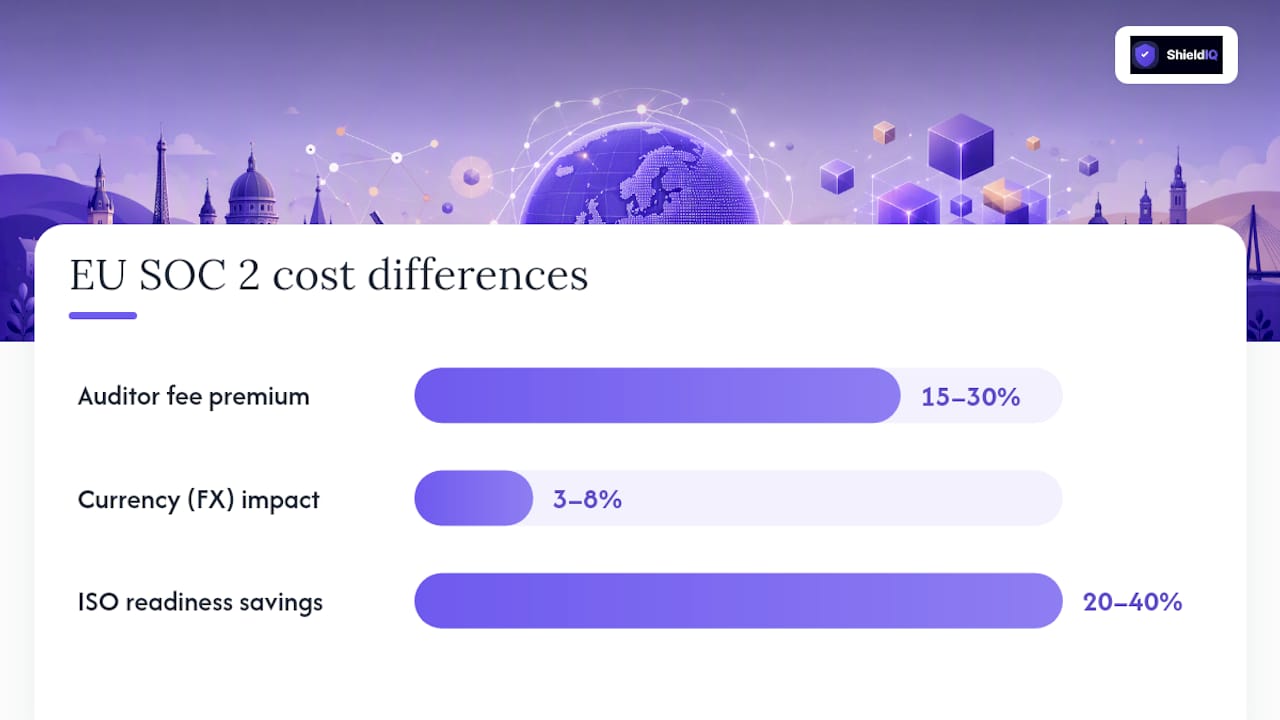
Auditor availability and pricing. The US market has a dense ecosystem of specialist SOC 2 firms competing on price, which keeps audit fees lower at the specialist tier. In the EU, fewer firms have deep SOC 2 experience, which reduces competitive pressure and can push fees 15–30% above equivalent US rates for comparable scope. EU companies often engage US-based CPA firms remotely, which introduces time-zone coordination costs and occasional travel expenses.
GDPR and data residency overlap. EU companies must ensure their system description accurately reflects GDPR obligations, particularly around data subject rights, processing records, and cross-border transfer mechanisms. This adds documentation work that US companies do not face, and it occasionally requires legal review of the system description itself before the auditor can finalise the report.
Currency and invoicing. Most SOC 2 auditor fees are quoted in USD. EU companies absorb foreign exchange risk across a twelve-to-eighteen-month engagement, which can add 3–8% to the effective cost depending on EUR/USD or GBP/USD movement during the period.
Framework overlap as a cost advantage. EU companies that already hold ISO 27001 certification or have mature GDPR controls have a genuine cost advantage. Many SOC 2 controls map directly to ISO 27001 Annex A controls, and a company with an existing ISMS can reduce its readiness spend by 20–40% compared with starting from scratch. This is one area where EU companies often outperform US counterparts who lack an equivalent baseline framework.
Customer expectations. US enterprise customers typically require SOC 2 Type 2 as a standard procurement requirement. EU enterprise customers are more likely to accept ISO 27001 as an equivalent, which means EU SMEs sometimes have more flexibility in choosing between frameworks. Comparing ISO 27001 and SOC 2 before committing to either is worth the time if your customer base is primarily European.
What happens financially if you fail a SOC 2 audit?
SOC 2 does not produce a binary pass or fail outcome in the way a certification audit does. Instead, auditors issue a report with or without exceptions. An exception means a control did not operate effectively during the observation period. The financial consequences depend on how many exceptions appear and how material they are.
Direct remediation costs. Each exception requires documented remediation. Depending on the control, remediation can range from a configuration change costing a few hours of engineering time to a process redesign costing $5,000–$20,000 in consultant and internal labour. If the exception is severe enough that a customer requires a bridge letter or a re-audit, add another $10,000–$30,000 to the programme cost.
Re-testing fees. Auditors charge for re-testing remediated controls. Expect $2,000–$8,000 per control area that requires re-testing, depending on the firm and the scope of the re-test.
Commercial consequences. A report with material exceptions can delay or kill enterprise deals. The cost of a lost deal is rarely quantified in compliance budgets, but for a SaaS company where a single enterprise contract is worth $100,000 or more annually, the commercial risk of a poor report dwarfs the remediation cost. This is the strongest argument for investing in readiness before the observation window opens rather than hoping gaps will not be discovered during fieldwork.
Reputational and contractual exposure. Some enterprise contracts include audit rights or compliance warranties. A report with exceptions can trigger contractual review clauses, customer audits, or, in regulated industries, regulatory scrutiny. EU companies operating in financial services or healthcare face heightened exposure here, particularly where DORA or sector-specific requirements overlap with SOC 2 scope.
The practical lesson is straightforward: the cost of fixing gaps before the audit is almost always lower than the combined cost of exceptions, re-testing, remediation under time pressure, and commercial delay.
Key takeaways
For EU SMEs, the total first-year SOC 2 programme cost is substantial, with the auditor fee being a significant but partial portion once readiness, tooling, and internal labour are included.
| Point | Details |
|---|---|
| First-year total cost range | Budget $30,000–$150,000 for a typical EU SME; auditor fee alone is $15,000–$60,000. |
| Readiness before observation | Complete gap assessment and remediation before the observation window opens to avoid costly exceptions. |
| Type I vs Type II decision | Go straight to Type II if your timeline allows six months of observation; Type I adds cost without replacing it. |
| Recurring annual costs | Year-two costs typically run 40–60% lower than year one; audit fee, platform licence, and pentest remain fixed. |
| ShieldIQ for EU SMEs | ShieldIQ’s automation platform reduces internal evidence-collection hours and produces audit-ready reports, cutting total programme cost. |
The budgeting mistake most EU SMEs make on SOC 2
The most persistent error is treating the auditor fee as the budget. It is not. The auditor fee is the most visible line item, but internal labour, which is the engineering and security time spent gathering evidence, writing policies, and remediating controls, is frequently the largest cost in the programme. It is also the hardest to forecast because it depends on how mature your controls are before you start.
The second mistake is omitting recurring costs from the planning conversation. SOC 2 is not a certificate you buy once. It is an annual attestation, and the costs of maintaining it, the audit fee, the platform licence, the pentest, the training, add up to a meaningful ongoing budget line. Finance teams that plan only for year one are setting up a difficult conversation in year two.
The corrective is simple: own the programme at the right level. SOC 2 should be owned by someone with both technical credibility and commercial awareness, whether that is your Head of Engineering, your CISO, or a virtual CISO engagement. Time the audit cycle to your contract renewal calendar. If your largest customer renews in Q4, your Type 2 report should be in their hands by Q3. Working backwards from that date tells you exactly when your observation window must start and, therefore, when your readiness work must be complete.
SOC 2 readiness without the overhead: how ShieldIQ helps
Getting to SOC 2 without a dedicated compliance team is where most EU SMEs struggle most. ShieldIQ is built specifically for that situation: an AI-powered GRC platform that handles the repeatable, time-consuming work of SOC 2 readiness so your engineering and security teams can focus on building rather than auditing.
The platform’s automated gap scanning identifies exactly where your controls fall short against SOC 2 Trust Services Criteria, and its AI-assisted policy engine generates audit-ready documentation in hours rather than weeks. Evidence collection runs continuously in the background, so when your auditor arrives, the evidence pack is already organised. For EU SMEs managing multiple frameworks simultaneously, ShieldIQ’s cross-framework controls mean that work done for GDPR or ISO 27001 carries directly into your SOC 2 programme, reducing duplication and total cost.
For teams that need hands-on support alongside the platform, ShieldIQ’s audit preparation and vCISO consulting services provide targeted expert input without the cost of a full-time hire. Start with a readiness assessment on the ShieldIQ SOC 2 platform to see exactly where you stand and what your programme will cost before you approach an auditor.
Useful sources and further reading
-
How Much Does A SOC 2 Audit Cost In 2026? The Real Numbers Nobody Publishes
-
SOC 2 Audit Cost 2026: $10K–$430K (Data From 171 Firms)
-
How Much Does a SOC 2 Audit Cost? A Complete, CPA-Led Guide | Expert Insights
-
SOC 2 Compliance for SaaS & Cloud Companies | ShieldIQ
-
SOC 2 automation for IT teams: a practical guide | ShieldIQ
-
Holistic AI governance, risk and compliance platform — GOV.UK
-
SIG — Shared Assessments