When to Hire a vCISO: A Guide for Irish and EU SMEs

You should hire a vCISO (a virtual chief information security officer, an experienced security leader engaged part-time or on retainer) when cyber risk has become a business question that nobody in your company owns. Usually a customer questionnaire, a tender, an insurer, a board member or a regulator forces the issue. If you have 10 to 250 staff, no security team and a deadline attached to one of those requests, the time is now, not after the next incident.
This guide is for IT managers, operations directors and compliance leads who are capable and busy but not security specialists. It also suits the MSPs and accountants who advise them. It is built around four jobs: passing an audit, answering a customer security questionnaire, reporting to the board, and handling an incident inside the regulator's clock.
Key Takeaways
- Hire a vCISO when an external party (customer, insurer, regulator, board) asks for security governance evidence that you cannot produce from inside the business.
- The model suits organisations that need leadership, strategy and compliance oversight without a full-time executive presence, which describes most SMEs.
- A vCISO leads and decides. Hands-on technical work such as configuring firewalls or running monitoring stays with your IT team or a managed provider.
- Ireland's NIS2 transposition is a moving target, but directors' exposure and customer expectations are already real. Do not wait for the law to settle.
- Before you hire, spend one week establishing your baseline, so the first paid days go on decisions rather than discovery.
Table of Contents
- What a vCISO actually does
- The triggers that tell you it is time
- Is your company the right size?
- The NIS2 question for Irish businesses
- vCISO or full-time CISO
- What good looks like once you hire
- How long it takes and what to expect
- What to do this week
- Our perspective
- How ShieldIQ fits
- FAQ
- Sources
What a vCISO actually does
A vCISO covers the strategic part of the CISO job: setting the security strategy, managing risk, overseeing compliance, checking supplier security, running awareness, leading incident response and reporting to the board. It is not hands-on technical delivery. ISACA's journal notes that organisations commonly procure virtual CISO services for one of two reasons: to put administrative and technical controls in place for a standard or regulation, or simply to have a dedicated person responsible for the security function.
That second reason matters for SMEs. Most businesses of your size already have someone who looks after IT. What they lack is someone accountable for security who can answer a customer, sit with an auditor and brief a board in plain terms.
The triggers that tell you it is time
The signs below come up repeatedly. Match yours to the job you are trying to do.
Job 1: you are heading into an audit
You are pursuing ISO 27001 or SOC 2, or a customer has made one a condition of renewal. Certification comes from an accredited body, not from your software or your adviser, and auditors expect to see a functioning management system: policies that are approved, risks that are assessed, controls that have evidence behind them. If nobody in the business can own that system, the audit stalls at the first request for evidence.
ISACA lists specific compliance mandates among the situations where a vCISO is worth considering, alongside small organisations with sensitive data and limited resources.
Job 2: a customer questionnaire you cannot answer
The most common trigger for Irish SMEs is a supplier security questionnaire from a larger customer: a bank, a utility, a hospital group or a public body. The questions ask who is responsible for security, whether you have a documented policy set, how you assess suppliers and how fast you would report an incident.
If you answer "the IT manager, informally" to three of those, you have your trigger. Large customers ask because they are themselves under pressure to manage their supply chains. If that is your situation, the point at which one questionnaire becomes several is the point to hire.
Job 3: reporting to the board
A board member, investor or new chair starts asking for a cyber risk view. Directors want to know the top risks, what is being done about them, what it costs and how you compare with what is expected. That is a reporting job, and it needs someone who can translate technical issues into business exposure.
Management accountability is also rising. Under NIS2 (Directive (EU) 2022/2555), Article 20 makes the management body responsible for approving and overseeing cybersecurity risk measures. Legal 500's 2026 Ireland chapter notes that the current NIS Regulations contain no specific obligation to appoint a CISO, but that directors and officers can face criminal liability for offences committed with their consent or through wilful neglect, and that NIS2, once transposed, places greater responsibility on senior management. Whether a particular obligation applies to you is a question of legal interpretation, so take legal advice on that point.
Job 4: handling an incident inside the regulator's clock
If you have had an incident or a near miss, or you realise you would not know who decides whether to notify, that is a trigger. The clocks are short. Under the GDPR, Article 33 requires a personal data breach to be notified to the supervisory authority (in Ireland, the Data Protection Commission) without undue delay and where feasible within 72 hours of becoming aware. Financial entities under DORA (Regulation (EU) 2022/2554) face their own staged reporting to the Central Bank of Ireland. Someone has to classify the incident, decide, and sign off. In a small company that person is often unclear until the worst moment.
Other signals
- Your cyber insurance application or renewal asks for governance evidence you do not have.
- Your CTO or IT manager owns security by default, alongside everything else.
- There is no written security strategy, and no tested response plan.
- You are growing fast, entering a new market or adopting AI tools, and the risk is outrunning your controls.
- A previous audit or penetration test produced findings that nobody owns.
Is your company the right size?
A vCISO fits best when you are big enough to carry real obligations and too small to justify a full-time executive. In practice that is the 10 to 250 employee band this article is written for. Below ten staff, a clear set of policies and a good baseline assessment may be enough. Towards the upper end, with complex regulation, multiple countries or security engineering at the core of your product, the case for a full-time CISO strengthens.
| Situation | Typical fit |
|---|---|
| 10 to 50 staff, first big customer or tender | vCISO for a defined project, then a light retainer |
| 50 to 250 staff, NIS2 sector, ISO 27001 or SOC 2 goal | vCISO retainer with a named internal owner |
| Regulated financial entity, DORA applies | vCISO plus an internal owner for ICT risk |
| 250+ staff, several jurisdictions, security is the product | Full-time CISO, possibly supported by a vCISO |
ISACA also points out that when the aim is a subset of a security programme rather than building the whole thing, a vCISO is an excellent choice, and that one can add value during the gap before a permanent CISO is hired.
For a sensible growth path, many EU fintechs and scaling SMEs move in this order: vCISO first, an internal security manager second, a full-time CISO later when the workload justifies it.
The NIS2 question for Irish businesses
NIS2 is the reason many Irish SMEs are asking this question, so it is worth being precise. The directive's transposition deadline was October 2024, and Ireland's national legislation has been slower than most Member States. Check the NCSC-IE for the current position before you plan around any date.
Three points hold whatever the legislative timetable:
- Your customers in regulated sectors are already flowing NIS2-style requirements down to suppliers through contracts and questionnaires.
- The existing NIS rules continue to apply to operators of essential services until replaced.
- Medium-sized businesses in the listed sectors are generally within scope of NIS2, while smaller ones usually are not unless an exception applies. Which category you fall into can depend on your sector and group structure, so confirm it with legal advice.
Waiting for the law to land before appointing someone accountable is a poor trade. The evidence you need (policies, a risk register, supplier records, an incident plan) takes months to build.
vCISO or full-time CISO
A full-time CISO makes sense when the job is bigger than prioritising, governing and reporting: when you need sustained, daily cross-functional leadership, or a team to manage. For most SMEs, that is not yet the case, and the cost is not proportionate.
Cost is the main reason the vCISO model exists. CSO Online reported in 2018 that virtual CISOs are estimated to cost between 30% and 40% of a full-time CISO, are available on demand and need no training. Treat that as an indicator from one publication rather than a quote: your actual cost depends on scope, hours and the provider.
The practical difference is time and focus. A vCISO gives you senior judgement for a set number of days each month, with a fixed agenda, rather than a permanent seat. That is exactly what governance, compliance oversight and board reporting need at SME scale.

What good looks like once you hire
A vCISO engagement works when it is specific. Before you sign, agree these in writing:
- A named business owner on your side who makes decisions and chases actions.
- A fixed meeting cadence, monthly at minimum, with a short written output each time.
- A written backlog of risks and actions, ranked by business impact.
- Scope boundaries: leadership, policy, risk, supplier oversight, board reporting and incident governance sit with the vCISO. Day-to-day technical delivery and monitoring stay with your IT team or a managed security provider.
- A 12 to 24 month roadmap tied to the job you hired for: the audit, the customer requirement, the board pack or the incident process.
ISACA's 2021 article stresses that the value of the model depends on clear scope. A vague brief produces a retainer that generates meetings but no evidence.
How long it takes and what to expect
Be honest with your board about time. A first baseline assessment can take around 15 minutes with the right tool. Turning that into approved policies, a populated risk register and evidence an auditor will accept typically takes months, not weeks. A first questionnaire response backed by real documents is realistic in weeks. A certification such as ISO 27001 is a longer project, and the audit itself is carried out by an accredited certification body.
Plan for a steady rhythm rather than a sprint: a few focused days a month from a vCISO, plus a few hours a week from your internal owner.
What to do this week
- Name the job (30 minutes). Is it an audit, a questionnaire, a board report or an incident process? Write the date and the requester next to it.
- Collect the asks (1 hour). Gather every customer questionnaire, tender clause, insurer form and board request from the last 12 months. Highlight the questions you could not answer.
- Run a baseline (15 minutes to an hour). Assess yourself against one framework so you have a scored list of gaps. NIST CSF 2.0 is a sensible neutral starting point.
- Name an internal owner (30 minutes). One person who will take the vCISO's calls and make decisions.
- Write a one-page brief (1 hour). Job, deadline, scope, what stays with IT, and the outputs you expect each month.
- Check who is in scope (1 hour). Note your sector and headcount and ask for legal advice if NIS2 or DORA may apply.
Our perspective
We built ShieldIQ in Ireland for teams that do not have a security team: SMEs, and the IT managers, operations directors and compliance leads inside them. The pattern we see in the problem is simple. The business is asked for evidence, and nobody has had the time to turn good intentions into documents.
Our view is that a vCISO is most useful when the groundwork is already visible. A leader who starts from a scored baseline, a draft policy set and a populated risk register spends their days on decisions and priorities. That is why we pair a platform with optional consulting, including a virtual CISO, for readers who want a human alongside the software.
The platform helps you assess, prioritise, document and evidence compliance. Certification comes from an accredited body, and nobody can honestly promise you a pass in advance.
Matthew Lemon
How ShieldIQ fits
ShieldIQ is an AI-powered GRC platform built in Ireland, with customer data hosted in the EU (Ireland) on AWS. AI analysis is processed by Anthropic (Claude), which does not train on customer data. It supports 17 frameworks, including NIS2, GDPR, ISO 27001, DORA, the EU AI Act, NIST CSF 2.0, SOC 2 and PCI DSS 4.0. NIST CSF 2.0 is free to assess, which gives you the baseline in about 15 minutes. The other frameworks are on paid plans, listed on the pricing page.
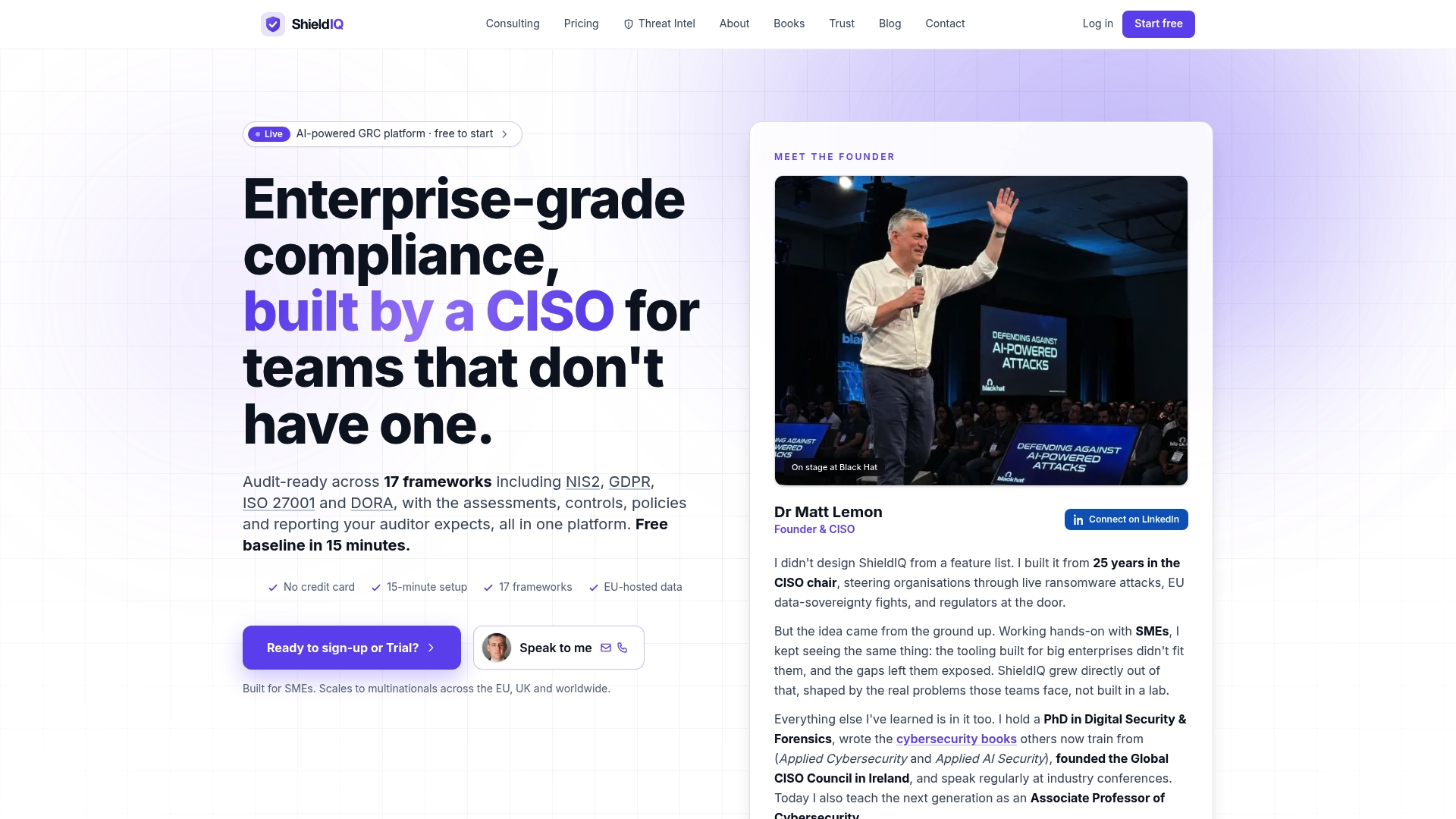
If you want an experienced person alongside the software, our vCISO and consulting services cover security leadership, risk assessment, incident response preparation and awareness training. You can also read our guide to the virtual CISO role for Irish SMEs, or start at ShieldIQ.
FAQ
What are the main benefits of a vCISO?
You get senior security judgement without a full-time salary, a written strategy instead of ad-hoc projects, and someone who can speak to boards, customers and insurers. It also helps you spend a limited security budget on the risks that matter most.
How do I choose the right vCISO service?
Start from your job: audit, questionnaire, board report or incident process. Then ask for a defined scope, a named owner on your side, a monthly cadence and written outputs. Look for experience in your sector and frameworks, and be clear what stays with your IT team.
Is a vCISO enough for a regulated financial firm?
Often it is a good first step, paired with an internal owner for ICT risk. Under DORA (Regulation (EU) 2022/2554), accountability remains with your management body, so the vCISO supports rather than replaces that responsibility. Multi-country regulated groups with complex obligations may eventually need a full-time CISO. Take legal advice on your specific obligations.
Do I need a vCISO if I only handle one questionnaire?
A single questionnaire can often be handled with a good baseline and policy set. If questionnaires are recurring, or if the customer wants named accountability and board reporting, a vCISO is the more durable answer.
Sources
- ISACA Journal 2021, Virtual CISOs: Security Leader or Security Risk
- ISACA Journal 2022, Volume 2 HelpSource
- CSO Online, What is a virtual CISO? When and how to hire one
- Legal 500, Ireland Data Protection and Cybersecurity 2026
- NCSC-IE